Contents 2 min read
Important Note
This page is not medical advice. Although the potential benefits of PQQ are supported by research, it should not be used to treat any health problems. Consult a healthcare professional.
What is PQQ?
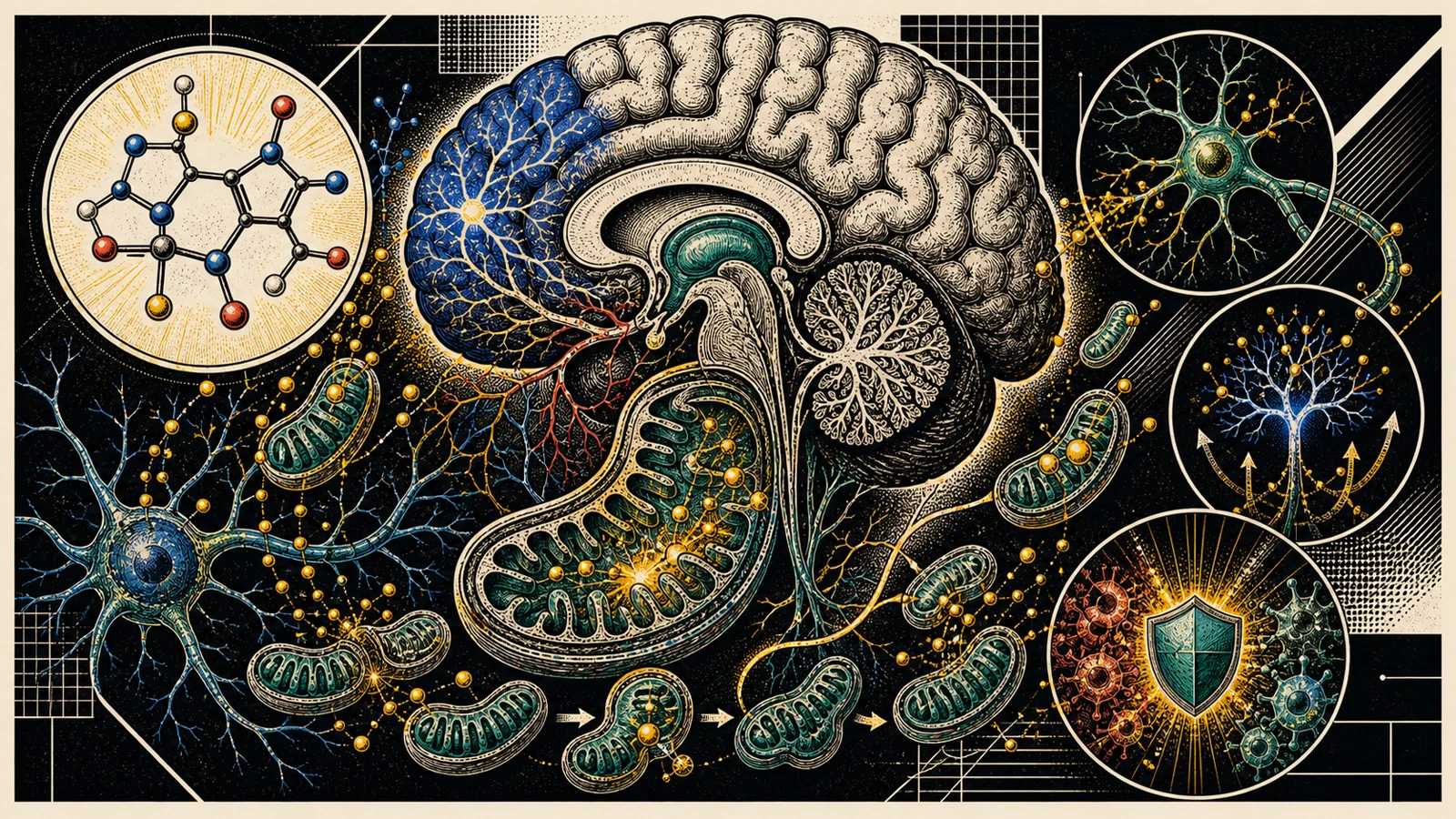
Pyrrolo Quinoline Quinone (PQQ) is a small molecule discovered in 1979 that structurally functions as a cofactor. In 2003, Japanese scientists suggested that PQQ may be an essential nutrient for mammals; This finding has created great interest. PQQ works as an enzyme cofactor in bacterial and plant metabolism and is found in nature in low concentrations in fermented foods (natto, miso), cheese, green tea and breast milk.
The most striking feature of PQQ is mitochondrial biogenesis - that is, the production of new mitochondria from scratch in cells - It can warn. Mitochondrial biogenesis is considered a critical mechanism in brain health and general aging processes.
Mechanism of Effect

| mechanism | target | Conclusion |
|---|---|---|
| Mitochondrial biogenesis | PGC-1α activation | Formation of new mitochondria, increase in cellular energy |
| Powerful antioxidant | ROS scavenging (5000+ cycles of catalysis) | Neuron protection against oxidative damage |
| CREB activation | Neuronal gene expression | Increased BDNF synthesis |
| Neurotoxin protection | Glutamate excitotoxicity reduction | Neuronal survival support |
Difference between PQQ and CoQ10
CoQ10 is also a critical cofactor for mitochondrial function; However, the two molecules act through different mechanisms. CoQ10 supports the electron transport chain in existing mitochondria, while PQQ production of new mitochondria warns. This is why some experts recommend the synergistic use of the two substances – CoQ10 optimizes the efficiency of existing mitochondria, while PQQ expands mitochondrial capacity.
Clinical Trials
Human research is limited but promising. A 2012 Japanese study (Nakano, etc.) found that 20 mg/day PQQ supplement significantly improved attention, working memory, and cognitive processing speed in older individuals compared to placebo. In the same study, a significant decrease in CRP (inflammation marker) and LDL oxidation was also detected.
Dosage Protocol
| Intended Use | Dose | Timing |
|---|---|---|
| General neuroprotection/mitochondrial support | 10–20 mg/day | Morning, with food |
| Dose used in studies | 20 mg/day | morning |
| Combination with CoQ10 | 10–20 mg PQQ + 100–200 mg CoQ10 | Morning with a fatty meal |
Safety and Side Effects
PQQ demonstrated a safe profile at dosages tested in studies (10–20 mg/day). Nephrotoxicity was observed in high-dose animal studies (0.4 mmol/kg); However, this dose is much higher than the level used in humans. There are no known drug interactions; There is insufficient safety data in pregnant and breastfeeding individuals.
Sources
- Nakano M, et al. (2012). Effect of pyrroloquinoline quinone (PQQ) on mental status of middle-aged and elderly persons. Food Style 21, 16(7), 281–287. Search PubMed (match unverified)
- Stites T, et al. (2006). Pyrroloquinoline quinone modulates mitochondrial quantity and function in mice. Journal of Nutrition, 136(2), 390–396. PubMed · PMID 16424117
- Rucker R, et al. (2009). Potential physiological importance of pyrroloquinoline quinone. Alternative Medicine Review, 14(3), 268–277. Search PubMed (match unverified)
- Misra HS, et al. (2012). Pyrroloquinoline-quinone and its versatile roles in biological processes. Journal of Biosciences, 37(2), 313–325. PubMed · PMID 22581337
Link verification checks the identity of the publication; it does not constitute independent expert review of clinical claims. Our evidence and source methodology · Source directory
Frequently Asked Questions
PQQ (Pyrrolo Quinoline Quinon) supports the production of new mitochondria in cells by stimulating mitochondrial biogenesis. With its strong antioxidant properties, it protects brain cells from oxidative damage and supports cognitive performance through BDNF synthesis.
While CoQ10 increases the energy production efficiency of existing mitochondria, PQQ stimulates the formation of new mitochondria from scratch. The two substances complement each other through synergistic mechanisms; The combination provides bidirectional support in terms of mitochondrial capacity and efficiency.
10–20 mg/day has been used in human studies. It is recommended to take it in the morning with food; For fat solubility, taking it with a meal containing fat may increase bioavailability.
Yes, but at very low concentrations. Natto, miso, spinach, green pepper and breast milk are the best sources. The amount taken from foods (in micrograms) remains well below supplement doses (in milligrams); therefore supplementation is necessary to achieve levels in studies.


