Contents 4 dk okuma
Claim and source comparison
Comparison scope: PubMed abstracts of Bhagavan 2006, Sandor 2005, Storch 2007 and QE3 2014; official NCCIH summary. A pharmacokinetic review, distinct patient groups and medication cautions were examined; not independent clinical review.
· Bounded source comparison; not a complete clinical review or independent medical endorsement.
Narrative review
Bhagavan 2006, a narrative review, reports about 6 hours Tmax and a 33-hour elimination half-life for CoQ10; absorption depends on formulation. The abstract does not present 33 hours as a ubiquinol-specific measurement.
This is not a new pharmacokinetic trial. The educational curve uses an approximate review value, not validated for every product, brain level, onset or personal redosing. Animal tissue uptake is not human brain benefit.
Source 1 · Abstract read
Human randomized controlled trial
Sandor 2005 randomized 42 migraine patients in a double-blind comparison of CoQ10 100 mg × 3/day with placebo. Some headache outcomes improved in month three; 50% attack-frequency responder rates were 47.6% with CoQ10 and 14.4% with placebo.
A small migraine trial does not demonstrate memory or energy enhancement in healthy people. Its divided dose is not a personal schedule; responder rates do not guarantee equal benefit in every patient.
Source 2 · Abstract read
Human randomized controlled trial
Storch 2007: 131 patients on stable Parkinson therapy received nanoparticular CoQ10 100 mg × 3/day or placebo for three months. UPDRS II/III change did not differ (p=0.82); add-on CoQ10 showed no symptomatic benefit.
This symptom trial is distinct from QE3 on progression in early Parkinson disease. The nanoparticular product cannot be assumed milligram-equivalent to a standard product; results do not transfer to healthy cognition.
Source 3 · Abstract read
Human randomized controlled trial
QE3 2014: 600 early Parkinson patients were assigned placebo, 1200 or 2400 mg/day CoQ10; all received 1200 IU/day vitamin E. Stopped at a prespecified futility criterion. UPDRS worsening was 6.9, 7.5 and 8.0 points respectively; no clinical benefit.
High research doses tolerated in this patient group are not personal safe upper limits. Results support neither Parkinson treatment nor healthy cognitive-enhancement advice; vitamin E context is retained.
Source 5 · Abstract read
Official safety summary
NCCIH: CoQ10 may cause insomnia or digestive upset and interact with warfarin, insulin and some cancer treatments. The same effect cannot be attributed to all blood thinners. Do not stop medication independently; missing interaction records are not safety evidence.
The official summary gives neither side-effect frequencies nor a universal 300 mg/day safety limit. Specific drug cautions are separated from an unverified generic blood-pressure-lowering label.
Source 6 · Official summary read
Correction 2026-11-11: Parkinson trial objectives were distinguished. The review's 33 hours were not attributed exclusively to ubiquinol; generic dosing, side-effect frequencies and timing instructions were removed.
What is Coenzyme Q10?
CoQ10 participates in cellular energy metabolism. This biochemical role does not prove supplementation improves memory or energy in healthy people; clinical findings are bounded by patient group and formulation.
Ubiquinol or Ubiquinone?
Ubiquinol and ubiquinone interconvert in the body. Absorption depends on product formulation; ubiquinol has not been established as superior for every product, age group or clinical outcome.
Mechanism of Effect
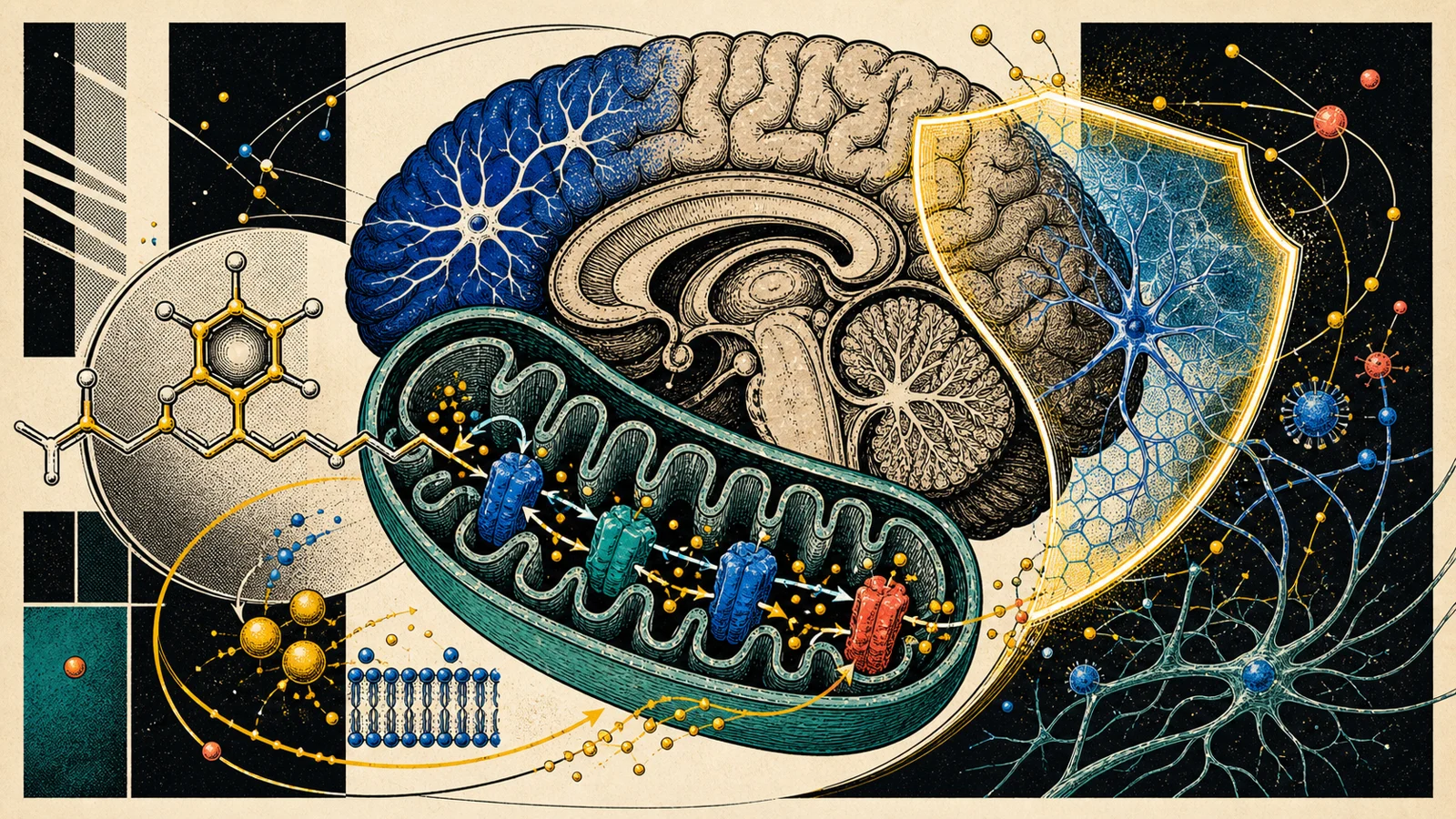
The most fundamental role of CoQ10 is in the electron transport chain in the inner membrane of mitochondria. The CoQ10 molecule receives electrons from Complex I (NADH dehydrogenase) and Complex II (succinate dehydrogenase). to complex III (cytochrome bc1 complex) carries. This electron transfer creates a proton gradient between the two sides of the membrane, which activates ATP synthase (Complex V) and produces ATP, the basic energy unit of the cell.
Bhagavan 2006, a narrative review, reports about 6 hours Tmax and a 33-hour elimination half-life for CoQ10; absorption depends on formulation. The abstract does not present 33 hours as a ubiquinol-specific measurement.
This is not a new pharmacokinetic trial. The educational curve uses an approximate review value, not validated for every product, brain level, onset or personal redosing. Animal tissue uptake is not human brain benefit.
Clinical Trials
Sandor 2005 randomized 42 migraine patients in a double-blind comparison of CoQ10 100 mg × 3/day with placebo. Some headache outcomes improved in month three; 50% attack-frequency responder rates were 47.6% with CoQ10 and 14.4% with placebo.
A small migraine trial does not demonstrate memory or energy enhancement in healthy people. Its divided dose is not a personal schedule; responder rates do not guarantee equal benefit in every patient.
Storch 2007: 131 patients on stable Parkinson therapy received nanoparticular CoQ10 100 mg × 3/day or placebo for three months. UPDRS II/III change did not differ (p=0.82); add-on CoQ10 showed no symptomatic benefit.
This symptom trial is distinct from QE3 on progression in early Parkinson disease. The nanoparticular product cannot be assumed milligram-equivalent to a standard product; results do not transfer to healthy cognition.
QE3 2014: 600 early Parkinson patients were assigned placebo, 1200 or 2400 mg/day CoQ10; all received 1200 IU/day vitamin E. Stopped at a prespecified futility criterion. UPDRS worsening was 6.9, 7.5 and 8.0 points respectively; no clinical benefit.
High research doses tolerated in this patient group are not personal safe upper limits. Results support neither Parkinson treatment nor healthy cognitive-enhancement advice; vitamin E context is retained.
According to NCCIH, overall evidence does not support CoQ10 for reducing statin-related muscle pain. Lower plasma levels alone prove neither the cause of pain nor supplementation benefit.
Dose information and research limits
Dose information and research limits
This dose information describes research or product context; it is not a personal prescription, established safe upper limit or efficacy guarantee for healthy people. Extracts and different formulations should not be treated as equivalent milligram for milligram.
Controlled studies have not adequately established the efficacy and safety of these combinations in healthy people. Theoretical complementarity is not proven synergy or a recommendation to combine them.
Safety and Side Effects
NCCIH: CoQ10 may cause insomnia or digestive upset and interact with warfarin, insulin and some cancer treatments. The same effect cannot be attributed to all blood thinners. Do not stop medication independently; missing interaction records are not safety evidence.
The official summary gives neither side-effect frequencies nor a universal 300 mg/day safety limit. Specific drug cautions are separated from an unverified generic blood-pressure-lowering label.
Related research and reading
These links show explicit editorial topic connections; they do not confirm a mechanism, efficacy or the safety of combined use. News dates refer to the source or event.
Educational guides
- Mitochondria and Brain Energy: Mechanisms and Evidence
Explore CoQ10, PQQ, NMN and creatine research; mitochondrial mechanisms do not explain every cause of brain fog or guarantee supplement benefits.
Sources
- Bhagavan, H.N., Chopra, R.K. (2006). Coenzyme Q10: absorption, tissue uptake, metabolism and pharmacokinetics. Free Radical Research, 40(5), 445–453. PubMed · PMID 16551570
- Sandor, P.S. et al. (2005). Efficacy of coenzyme Q10 in migraine prophylaxis: a randomized controlled trial. Neurology, 64(4), 713–715. PubMed · PMID 15728298
- Storch, A. et al. (2007). Randomized, double-blind, placebo-controlled trial on symptomatic effects of coenzyme Q(10) in Parkinson disease. Archives of Neurology, 64(7), 938–944. PubMed · PMID 17502459
- Littarru, G.P., Tiano, L. (2007). Bioenergetic and antioxidant properties of coenzyme Q10: recent developments. Molecular Biotechnology, 37(1), 31–37. PubMed · PMID 17914161
- Parkinson Study Group QE3 Investigators, et al. (2014). A randomized clinical trial of high-dosage coenzyme Q10 in early Parkinson disease: no evidence of benefit. JAMA Neurology, 71(5), 543–52. https://doi.org/10.1001/jamaneurol.2014.131 PubMed · PMID 24664227
- NIH National Center for Complementary and Integrative Health. Coenzyme Q10. https://www.nccih.nih.gov/health/coenzyme-q10 NIH NCCIH
Link verification checks the identity of the publication; it does not constitute independent expert review of clinical claims. Our evidence and source methodology · Source directory
Frequently Asked Questions
CoQ10 participates in cellular energy metabolism. This biochemical role does not prove supplementation improves memory or energy in healthy people; clinical findings are bounded by patient group and formulation.
Ubiquinol and ubiquinone interconvert in the body. Absorption depends on product formulation; ubiquinol has not been established as superior for every product, age group or clinical outcome.
According to NCCIH, overall evidence does not support CoQ10 for reducing statin-related muscle pain. Lower plasma levels alone prove neither the cause of pain nor supplementation benefit.
High research doses tolerated in this patient group are not personal safe upper limits. Results support neither Parkinson treatment nor healthy cognitive-enhancement advice; vitamin E context is retained.
This is not a new pharmacokinetic trial. The educational curve uses an approximate review value, not validated for every product, brain level, onset or personal redosing. Animal tissue uptake is not human brain benefit.


