Contents 4 dk okuma
Important Note
This page is not medical advice. While the potential benefits of creatine are supported by research, it should not be used to treat any health problems. Consult a healthcare professional.
What is Creatine?
Creatine is a natural compound that the body synthesizes from the amino acids arginine, glycine and methionine by the liver, kidney and pancreas. It is consumed primarily from red meat and fish in the diet; Vegetarians and vegans have much lower serum creatine levels.
Although creatine has been known as a sports supplement for decades, its nootropic effects on the brain have entered the research agenda in the last two decades. Although not as dense as muscles, brain tissue stores creatine and benefits from the phosphocreatine/ATP system. During periods of intense mental work, sleep deprivation, or stress, brain energy demand increases dramatically; At this point, creatine supplementation can make a measurable difference.
Mechanism of Effect

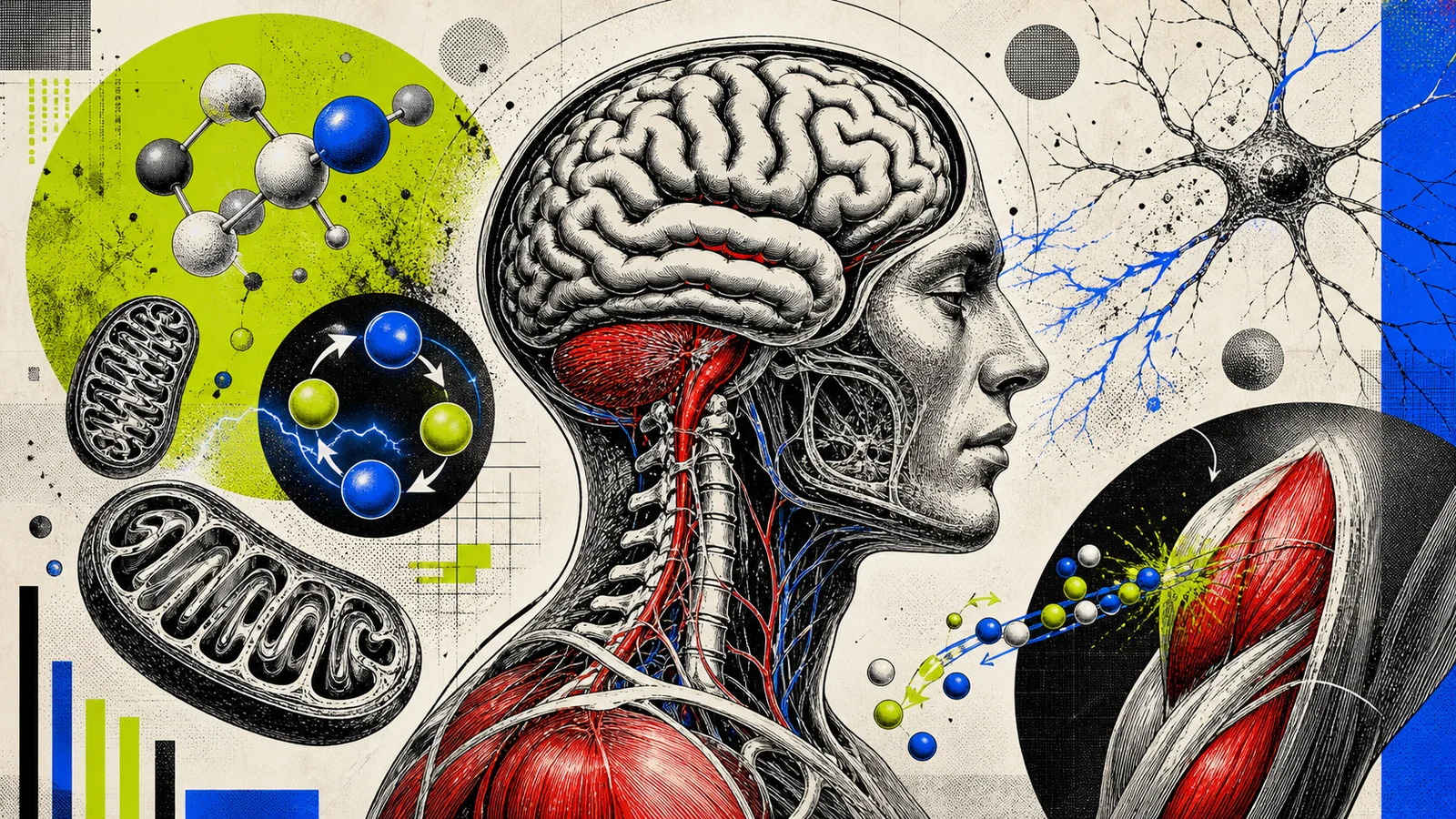
The main effect of creatine on the brain expands the phosphocreatine (PCr) pool It is caused by. PCr is the emergency energy store used to regenerate rapidly depleted ATP. Enlarging this buffer in high-energy-consuming organs such as the brain ensures that cognitive performance is maintained under pressure.
| mechanism | Impact | Level of Evidence |
|---|---|---|
| PCr/ATP buffer capacity | ATP regeneration delay in sudden energy demands, cognitive fatigue | Strong |
| Mitochondrial energy transfer | Energy transfer across the inner membrane is facilitated by the creatinine kinase enzyme. | Strong |
| Neuroprotection (oxidative stress) | Neuronal protection against glutamate toxicity and oxidative damage | medium |
| Calcium homeostasis | Apoptosis inhibition by mitochondrial calcium buffering | medium |
| BDNF modulation | Increased BDNF has been observed in animal models; not yet confirmed in humans | Low-Medium |
Clinical Evidence
Rae et al. (2003) In their double-blind placebo-controlled study on 45 vegetarian adults, they showed that the use of 5 g/day creatine monohydrate provided statistically significant improvements compared to placebo in both short-term memory (digit span) and reasoning (Raven Progressive Matrices) tests at the end of 6 weeks. The stronger response in vegetarians compared to meat-consuming individuals indicates a compensatory effect for essential creatine deficiency.
Watanabe et al. (2002) showed that creatine supplementation under sleep deprivation conditions significantly delayed cognitive fatigue. Brain oxygenation during mental work was monitored using near infrared spectroscopy (NIRS); It was observed that mental fatigue decreased and oxygen use increased in the creatine group.
Avgerinos et al. (2018) A systematic review by , examined five RCTs and concluded that creatine showed consistent but moderate effects (Cohen's d ≈ 0.3–0.4) on memory and intelligence tests. The effects are particularly pronounced in stress, sleep deprivation, and vegetarian populations.
⚠ Research Limitations
The majority of existing studies were conducted in participants with low baseline creatine levels (vegetarian, vegan, or elderly). Cognitive gains may be more limited in healthy young individuals who consume meat. There is not yet sufficient data for long-term effects on the brain.
Dosage Protocol
The dosage that optimizes brain effects for creatine largely overlaps that used for muscle performance. The loading phase may speed up the delivery of creatine to the brain, but it is not essential.
| Intended Use | Dose | Timing |
|---|---|---|
| Cognitive support (general) | 3–5 g/day | Dissolved in water at any time |
| Loading phase (optional) | 20 g/day × 5–7 days (divided into 4 equal doses) | with meals |
| maintenance dose | 3–5 g/day | Continuous use, no cycle required |
| elderly individuals | 5g/day | Morning or lunch, with meal |
Form selection: Creatine monohydrate is the best researched and most economical of all forms. There is no reliable data proving the superiority of variants such as creatine HCl or ethyl ester; monohydrate should be preferred.
Safety and Side Effects
Creatine is one of the substances with the most comprehensive safety data in human supplement history. No serious side effects were reported in studies spanning decades and thousands of participants.
- Water retention: Initially, muscle and intracellular water retention may be observed; It may have a 1–2 kg effect on weight, it is not negative for the brain.
- Gastrointestinal discomfort: Rare; Nausea may occur during the loading phase. Dividing the dose or taking it with food solves the problem.
- Risk of hair loss (theoretical): There is limited evidence that it can increase DHT levels; Caution may be exercised in those with genetic predisposition.
Who Does It Interact With?
- Caffeine: High caffeine consumption may slightly reduce creatine stores; It is not a serious interaction.
- Kidney problems: Individuals with existing kidney disease must obtain physician approval; No harmful effects on the kidneys have been observed in healthy individuals.
- Other nootropics: Compatible with Alpha-GPC, Lion's Mane and Bacopa; It works synergistically with other supplements as it provides the brain's energy base.
Sources
- Rae C, et al. (2003). Oral creatine monohydrate supplementation improves brain performance: a double-blind, placebo-controlled, cross-over trial. Proceedings of the Royal Society B: Biological Sciences, 270(1529), 2147–2150. PubMed · PMID 14561278
- Watanabe A, et al. (2002). Effects of creatine on mental fatigue and cerebral hemoglobin oxygenation. Neuroscience Research, 42(4), 279–285. PubMed · PMID 11985880
- Avgerinos KI, et al. (2018). Effects of creatine supplementation on cognitive function of healthy individuals: a systematic review of randomized controlled trials. Experimental Gerontology, 108, 166–173. PubMed · PMID 29704637
- Benton D & Donohoe R (2011). The influence of creatine supplementation on the cognitive functioning of vegetarians and omnivores. British Journal of Nutrition, 105(7), 1100–1105. PubMed · PMID 21118604
- Dolan E, et al. (2019). A systematic analysis of creatine's ergogenic, performance, and safety profiles. Nutrients, 11(12), 2924. Search PubMed (match unverified)
Link verification checks the identity of the publication; it does not constitute independent expert review of clinical claims. Our evidence and source methodology · Source directory
Frequently Asked Questions
Creatine accelerates ATP regeneration at high energy demand by expanding the phosphocreatine (PCr) pool in the brain. In this way, it delays cognitive fatigue during periods of intense mental work, sleep deprivation or stress, and provides measurable improvements in short-term memory and reasoning tests. The effect is especially pronounced in vegetarian and vegan individuals with low base creatine levels.
3–5 grams of creatine monohydrate per day is sufficient for cognitive support. The loading phase (20 g/day, 5–7 days) may accelerate the delivery of creatine to tissues, but is not essential. When started directly with 3–5 g/day without loading, it may take 2–4 weeks for the effect to appear. Dose timing is not a determining factor on cognitive effect; It can be dissolved in water and taken at any meal of the day.
Creatine is one of the safest substances in supplement history. The most common side effect is an initial weight gain of 1–2 kg due to intracellular water retention; This situation is not negative for the brain. Nausea may rarely occur during the loading phase; Dividing the dose into meals prevents this. There is limited evidence that it may slightly increase DHT levels in individuals prone to hair loss. No harmful effects on the kidney or liver have been reported in healthy individuals.
Yes, creatine is freely sold as a food supplement in Türkiye; There are no legal restrictions. It is easily available in sports nutrition stores, pharmacies and online platforms. The best researched and most economical form is creatine monohydrate; There is no reliable data proving the superiority of variants such as creatine HCl or ethyl ester. Choosing micronized or Creapure certified brands when choosing products provides assurance of purity.
When the loading phase is applied, brain phosphocreatine stores are filled in approximately 1 week; When 3-5 g per day is taken without loading, tissue saturation is achieved in 2-4 weeks. In clinical studies, significant cognitive effects were generally measured after 4–6 weeks. Creatine does not require cycling; Regular use is recommended to maintain the benefit. When use is discontinued, stores decrease to basal levels within a few weeks and the cognitive advantage is lost.


