Contents 3 dk okuma
Information
This content is for educational and informational purposes only; It is not medical advice.
Why Does the Brain Use So Much Energy?
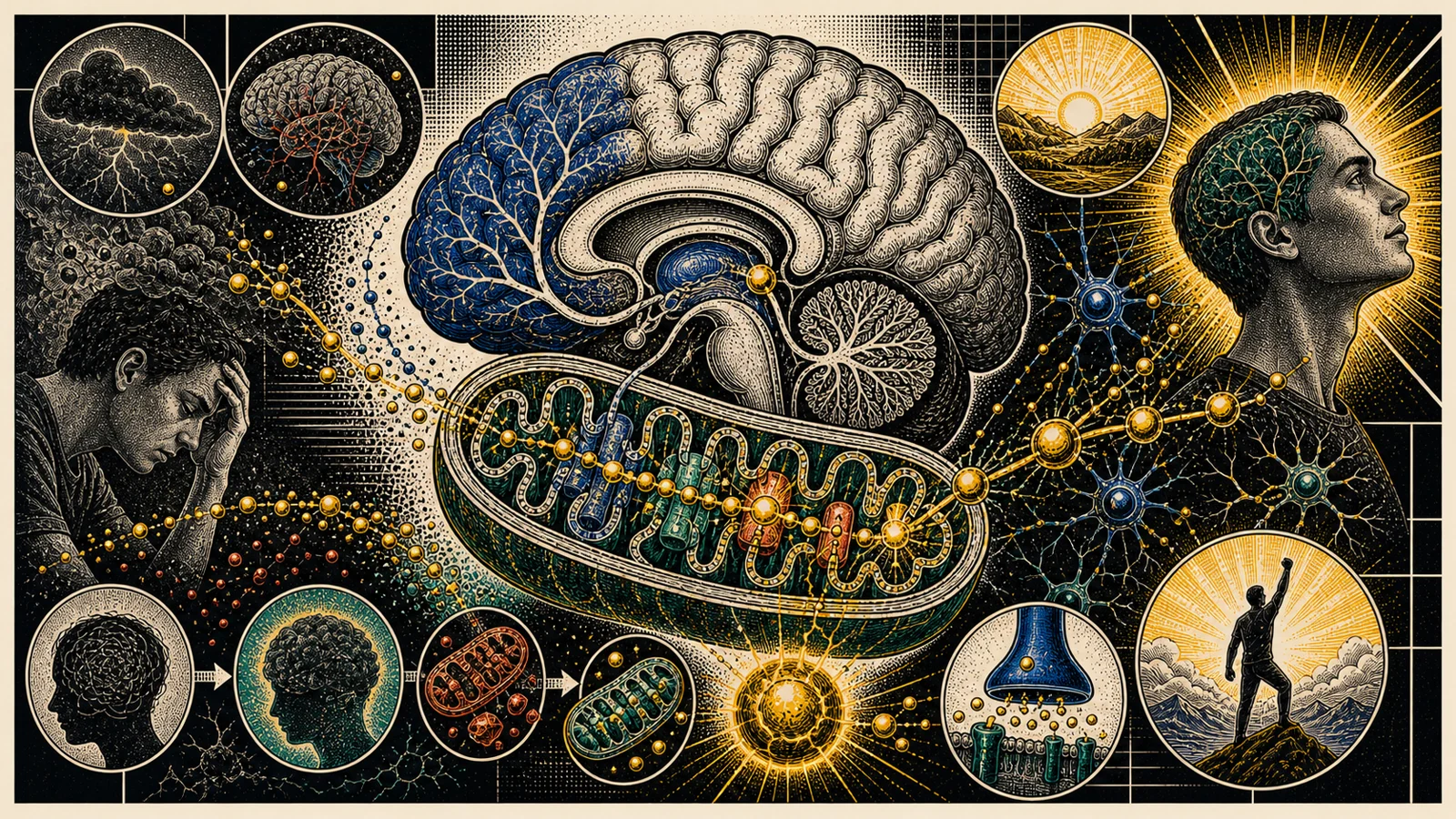
Even at rest, a neuron constantly consumes ATP to maintain its electrochemical balance thanks to ion pumps. This consumption spikes when a thought is generated, a memory is consolidated, or a synapse is strengthened (LTP). To meet this demand, the brain hundreds of mitochondria per neuron contains; It is particularly concentrated in dendrites and synaptic boutons.
Therefore, mitochondrial dysfunction manifests itself first and most obviously in the cognitive system. Even mild mitochondrial insufficiency brain fog, distraction, difficulty coming up with ideas, and loss of motivation can be experienced as.
Factors That Accelerate Mitochondrial Deterioration

- Aging: NAD+ levels drop dramatically after age 40; this slows down the SIRT1/PGC-1α pathway
- Chronic stress: Cortisol disrupts mitochondrial membrane potential
- Lack of sleep: The glymphatic system cleansing that occurs during the night also includes mitochondrial waste.
- Free radical accumulation: Electron transport chain leakage produces ROS; If antioxidant defenses are inadequate, damage accumulates
- Inactivity: Exercise is the most potent stimulator of mitochondrial biogenesis (PGC-1α); In its absence, biogenesis slows down
Nootropics That Support Mitochondrial Health
Coenzyme Q10 (CoQ10 / Ubiquinone)
CoQ10It carries electrons between Complexes I–III of the electron transport chain and is an indispensable component of ATP production. It also protects the mitochondrial membrane from ROS damage as a lipophilic antioxidant. It is especially important for statin users and individuals over the age of 40 because statins suppress CoQ10 synthesis. The ubiquinol form offers better bioavailability.
PQQ (Pyrrolo Quinoline Quinone)
PQQ differs from CoQ10 primarily by triggering the production of new mitochondria (biogenesis). Through PGC-1α activation, it not only repairs existing mitochondria but also increases their number. Its combination with CoQ10 is synergistic: CoQ10 optimizes the efficiency of existing mitochondria, while PQQ expands capacity.
NMN (Nicotinamide Mononucleotide)
NMNIt supports SIRT1 and SIRT3 activation by renewing NAD+ levels. SIRT3 increases electron transport chain efficiency by directly deacetylating mitochondrial protein. Normalization of the NAD+/NADH ratio, which decreases with age, rejuvenates mitochondrial energy production.
creatine
creatineIn case of sudden increases in ATP consumption, it reduces mitochondrial pressure by rapidly converting ADP back to ATP via phosphocreatine. It acts as an energy buffer in brain cells; Its effect is especially evident during intense mental effort and sleep deprivation conditions.
NAC (N-Acetyl Cysteine)
NACAs a precursor of glutathione, it neutralizes mitochondrial ROS. It is a powerful protector that limits mitochondrial damage, especially during periods of high oxidative load (chronic stress, post-infection fatigue).
Lifestyle Essentials in Mitochondrial Support
| factor | Mitochondrial Effect | Practical Suggestion |
|---|---|---|
| aerobic exercise | PGC-1α activation, mitophagy, biogenesis | 3–5 days per week, 30+ minutes at moderate intensity |
| Intermittent fasting (IF) | AMPK activation, mitophagy triggering | 16:8 window or 5:2 protocol |
| cold exposure | Brown adipose tissue activation, biogenesis | Cold shower or cryotherapy |
| sleep | Mitochondrial membrane repair, glymphatic clearance | 7–9 hours, consistent circadian rhythm |
Sources
- Mattson MP, et al. (2018). Mitochondria in neuroplasticity and neurological disorders. Neuron, 60(5), 748–766. Search PubMed (match unverified)
- Nakano M, et al. (2012). Effect of PQQ on mental status of middle-aged and elderly persons. Food Style 21, 16(7). Search PubMed (match unverified)
- Beal MF. (2004). Mitochondrial dysfunction and oxidative damage in Alzheimer's and Parkinson's diseases. Journal of Bioenergetics and Biomembranes, 36(4), 381–386. Search PubMed (match unverified)
- Mills KF, et al. (2016). Long-term administration of nicotinamide mononucleotide mitigates age-associated physiological decline in mice. Cell Metabolism, 24(6), 795–806. PubMed · PMID 28068222
Link verification checks the identity of the publication; it does not constitute independent expert review of clinical claims. Our evidence and source methodology · Source directory
Frequently Asked Questions
Yes. Brain fog — fuzzy thinking, inability to focus, difficulty finding words — can be a cognitive symptom of mitochondrial dysfunction. Mitochondrial support is worth investigating, especially in cases of chronic fatigue, post-COVID and conditions that worsen with age.
CoQ10 improves energy production efficiency by optimizing the electron transport chain in existing mitochondria. PQQ, on the other hand, triggers the formation of new mitochondria from scratch (biogenesis). The combination of the two complements each other due to synergistic mechanisms.
NAD+ levels begin to decline significantly around the age of 40. However, mitochondrial support may also be evaluated in younger individuals experiencing chronic stress, sleep disturbance, or ongoing fatigue. Exercise is the primary and most effective mitochondrial stimulator at all ages.
No. Creatine supports the energy buffer function of brain cells. Significant benefits on cognitive performance have been demonstrated under conditions such as intense mental work, sleep deprivation, and vegetarian diets. It applies to brain energy as well as sports performance.


