Contents 3 dk okuma
⚠ Drug Interaction Warning
St. John's Wort is a strong inducer of the CYP3A4 enzyme; Therefore, it can have serious interactions with many medications, such as antidepressants, birth control pills, anticoagulants (warfarin), HIV medications, heart medications (digoxin), and organ transplant medications (cyclosporine). If you are taking any medication, do not use it without consulting your doctor.
What is St. John's Wort?
St. John's wort (Hypericum perforatum) is a perennial plant belonging to the family of flowering plants. Native to Europe, Asia and North Africa, this plant has been used in traditional folk medicine for centuries for depression, anxiety, wound healing and nerve pain. It is known as St. John's wort or binbirdelik herb in Türkiye.
The plant has two main active compounds: the one that gives the yellow color and the one that has antioxidant properties. hypericin thought to be the primary mediator of the antidepressive effect with hyperforin. Standardized extract products are usually prepared to contain 0.3% hypericin or 3–5% hyperforin.
Mechanism of Effect

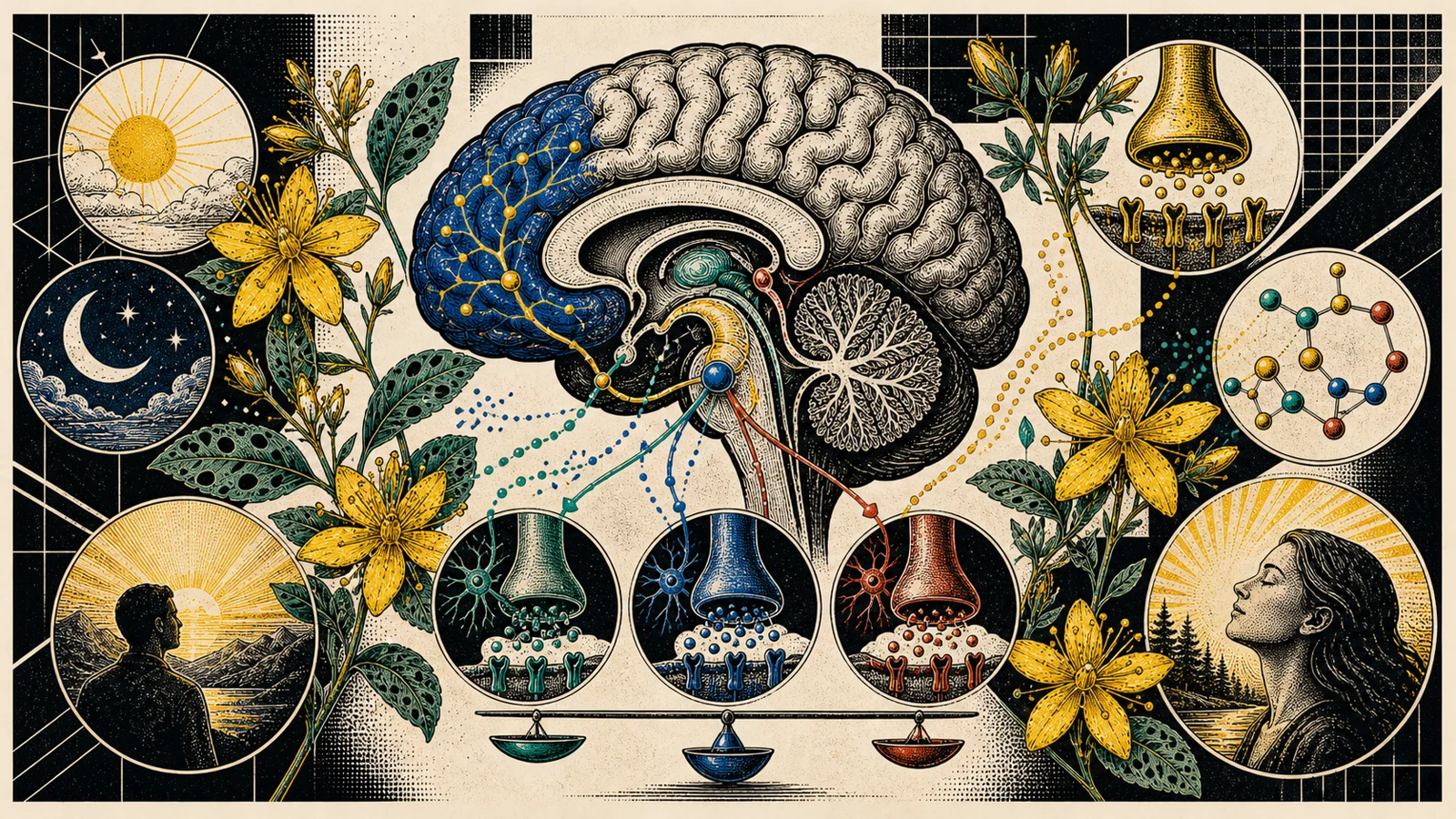
The antidepressive effect of St. John's wort works through a unique mechanism that affects multiple neurotransmitter systems:
| compound | mechanism | Impact |
|---|---|---|
| hyperforin | Serotonin, dopamine, norepinephrine reuptake inhibition | SSRI-like versatile effect |
| hyperforin | Sigma-1 receptor activation | Antidepressive, neuroprotective |
| hypercin | MAO-A/B inhibition (weak) | Decreased monoamine degradation |
| xanthons | GABA-A modulation | Anxiolytic additive |
Clinical Evidence
St. John's wort has surprisingly strong clinical evidence as an herbal preparation. A 2008 Cochrane meta-analysis covering 27 randomized controlled trials found that St. John's wort was significantly more effective than placebo in mild-to-moderate depression and was similar in effectiveness to standard antidepressants (tricyclics and SSRIs); It has also shown that it is much better tolerated in terms of its side effect profile.
However, a large NIH study published in 2001 involving 340 participants found that St. John's wort was not superior to placebo in severe depression. The consensus is this: Effective in mild to moderate depression, insufficient in severe depression.
Dosage Protocol
| Intended Use | Dose | Timing |
|---|---|---|
| Mild depression/mood support | 300 mg × 3/day (std. extract) | With meals, at regular intervals |
| seasonal affective disorder | 300–600 mg/day | Morning with light therapy |
| Anxiety support | 300 mg × 2–3/day | with food |
Extract standardization: Standard extracts containing 0.3% hypericin or 3–5% hyperforin should be preferred. Crude herbal forms may be inconsistent in compound concentration.
Safety and Drug Interactions
The most critical safety issue with St. John's wort is drug interactions. It reduces the effectiveness of many drugs through induction of CYP3A4 and P-glycoprotein:
- SSRI and antidepressants: Risk of serotonin syndrome (serious, should not be combined)
- Birth control pills: Hormonal contraception failure
- Warfarin: Decreased anticoagulant effect, risk of thrombosis
- Cyclosporine: Risk of organ transplant rejection
- HIV antiretrovirals, digoxin: Loss of drug effectiveness
- Increased sensitivity to sunlight (due to hypericin, especially in people with fair skin)
Sources
- Linde K, et al. (2008). St John's wort for major depression. Cochrane Database of Systematic Reviews. Search PubMed (match unverified)
- Hypericum Depression Trial Study Group. (2002). Effect of Hypericum perforatum (St John's Wort) in major depressive disorder. JAMA, 287(14), 1807–1814. Search PubMed (match unverified)
- Müller WE. (2003). Current St. John's Wort research from mode of action to clinical efficacy. Pharmacological Research, 47(2), 101–109. Search PubMed (match unverified)
- Borrelli F, Izzo AA. (2009). Herb–drug interactions with St John's Wort (Hypericum perforatum). AAPS Journal, 11(4), 710–727. Search PubMed (match unverified)
Link verification checks the identity of the publication; it does not constitute independent expert review of clinical claims. Our evidence and source methodology · Source directory
Frequently Asked Questions
St. John's wort (Hypericum perforatum) is an herbal antidepressant with clinically proven effectiveness for mild to moderate depression and anxiety. It has a positive effect on mood by inhibiting the reuptake of serotonin, dopamine and norepinephrine.
No, it is not safe with most medications. Serious interactions have been reported, especially with antidepressants (risk of serotonin syndrome), birth control pills (risk of failure), blood thinners, and organ transplant drugs. If you are taking any medication, be sure to consult your doctor.
No. Clinical evidence shows that St. John's Wort is effective for mild to moderate depression. The large NIH study found no superiority over placebo in severe major depression. Standard medical treatment is required for major depression.
Yes. It is known as 'St. John's Wort' or 'binbirdelik herb' in Türkiye and is sold in herbalists and pharmacies as a herbal supplement. Products containing standard extracts (such as Jarsin, Sigma-tau) should be preferred.


