Contents 5 dk okuma
Important Note
This page is not medical advice. Although the potential benefits of saffron extract are supported by clinical research, it should not be used alone to treat any psychiatric disorder. Consult a healthcare professional.
What is Saffron?
Saffron (Crocus sativus L.) is a plant species with purple flowers, known for being the most expensive spice per gram in the world. Only the three red-orange stigmas (stalks) of each flower are collected by hand; One kilogram of dried saffron requires approximately 150,000 flowers. Türkiye, especially in Karabük province Safranbolu The city is among the countries that have historical ties with saffron. It has been used in Persian and Indian medicine since ancient times as a mood stabilizer, aphrodisiac and digestive supporter.
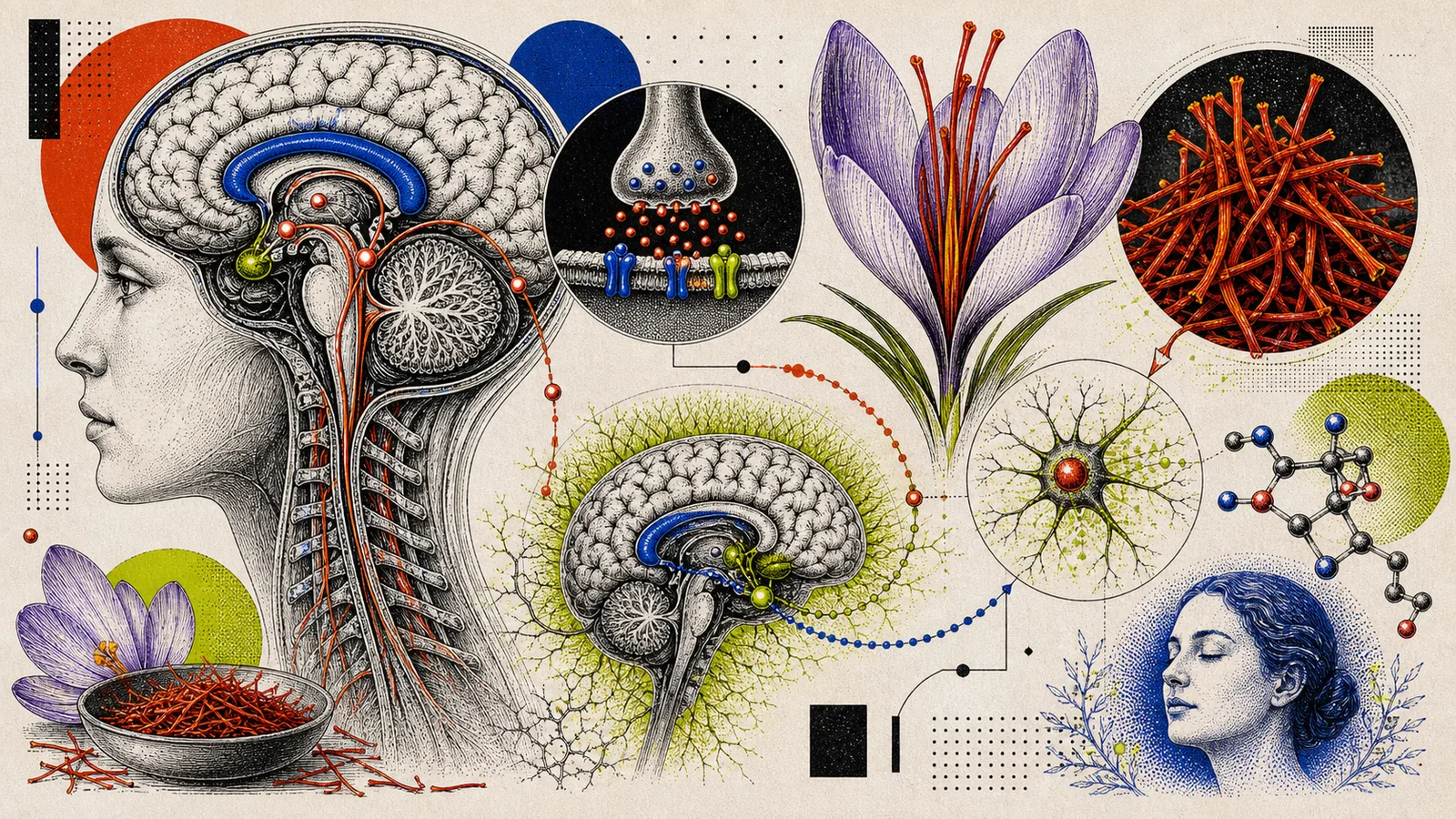
Modern psychiatric research confirms this traditional usage. The most active compounds of bile are examined in three groups: crocin (main water-soluble carotenoid; gives red color), crostetin (aglycone metabolite of crocin) and safranal (aromatic aldehyde in the essential oil fraction; responsible for the characteristic odor). The synergistic effect of these compounds has brought saffron to the focus of attention of psychiatric researchers.
Mechanism of Effect

It is understood that the antidepressant effect of saffron does not depend on a single mechanism, but works through more than one neurochemical pathway. This multi-target approach ensures that saffron is both well tolerated and offers a broad spectrum of psychiatric effects.
| compound | Mechanism of Effect | Psychiatric Outcome |
|---|---|---|
| crocin | Serotonin and dopamine reuptake inhibition | Increased mood, decreased depression |
| safranal | GABA-A receptor modulation | Anxiety reduction, calming |
| crostetin | Weak NMDA antagonism, oxidative stress reduction | Cognitive support, neuroprotection |
| carotenoids | Oxidative stress reduction, neuroinflammation inhibition | General neuroprotection |
Clinical Evidence
Saffron has among the strongest databases of randomized controlled trials (RCTs) among plant-derived nootropics. Most studies are of Iranian origin and have been conducted in regions where saffron has an indigenous cultural context; However, the results have also been replicated by independent teams.
Akhondzadeh et al. (2005) In a randomized, double-blind pilot study published by , 40 adult participants with mild to moderate depression were given either 30 mg/day saffron (Crocus sativus stigma) extract or 20 mg/day fluoxetine (Prozac) for 6 weeks. It was found that both groups showed similar improvement in Hamilton Depression Rating Scale scores; The side effect profile was also comparable. This is one of the early pilot studies (sample is small) that directly compared saffron to an SSRI.
Akhondzadeh et al. (2004) compared the tricyclic antidepressant imipramine with saffron stigma; reported that 30 mg/day saffron showed equivalent effectiveness to imipramine on symptoms of depression. Moshiri et al. (2006) In a double-blind study comparing the cheaper saffron petal extract with placebo, it was shown that the 30 mg/day dose significantly reduced depressive symptoms compared to placebo.
Hausenblas et al. (2013) In the meta-analysis published by , 5 RCTs were evaluated together; It has been shown that saffron supplementation statistically significantly reduces depressive symptoms compared to placebo. The average effect size was found to be medium-high.
For PMS symptoms: In a randomized controlled study (Agha-Hosseini et al., 2008), it was reported that 30 mg/day saffron provided a significant reduction in PMS-related mood lability and irritability compared to placebo. Lopresti and Drummond (2014) is a systematic review compiling the effects of saffron on depression and its antidepressant mechanisms of action.
Talaei et al. (2015) investigated the effect of saffron on drug-induced sexual dysfunction (decreased libido, difficulty in orgasm) in patients using SSRIs; reported that the addition of 30 mg/day of saffron significantly improved sexual function scores.
⚠ Research Context
The majority of existing studies were conducted with small sample sizes (20–60 participants) and short follow-up periods of 6–8 weeks. More comprehensive independent studies are needed for long-term effectiveness and safety. For moderate to severe depression, saffron cannot replace psychiatric treatment.
Dosage Protocol
Almost all clinical studies tested the same dose: 30 mg/day, usually 15 mg in the morning and evening, divided into two equal doses. This dose is the most supported dose in terms of both effectiveness and safety.
| Intended Use | Dose | Duration |
|---|---|---|
| Depression support | 30 mg/day (15 mg in the morning + 15 mg in the evening) | Evaluation after 6–8 weeks |
| anxiety | 30 mg/day | Ongoing, monthly review |
| PMS symptoms | 30 mg/day throughout the cycle | Try it for at least a month |
| Sexual dysfunction (SSRI add-on) | 30 mg/day | 4–6 weeks |
Product Selection
Raw saffron sold in the market as an "aphrodisiac" or "spice" is not the same as the standardized extracts used in research. For clinical effectiveness, choose standardized extracts of Iranian or Spanish origin with a stated percentage of crocin and safranal. Patented extracts such as Safraboost and Affron are referenced in research.
Safety and Side Effects
Saffron extract has one of the best safety profiles among nootropics with psychiatric effects. No serious side effects were reported in clinical studies. Possible mild side effects:
- dry mouth
- Mild headache (in the beginning)
- Nausea (when taken on an empty stomach)
- Mild changes in sleep patterns (rare)
⚠ Pregnancy Alert
Very high doses of saffron (over 5 grams, far beyond what is used in the kitchen) have been reported to cause uterine contractions and miscarriage. Although the 30 mg/day supplement dose used in studies is generally considered safe, it should not be used during pregnancy without consulting a doctor.
Drug interactions: Using saffron with antidepressants such as SSRIs or SNRIs may theoretically increase the risk of serotonin syndrome. Those who use these medications should definitely inform their doctors about using saffron. Caution should also be exercised when used with blood thinners.
Sources
- Akhondzadeh S, et al. (2004). Comparison of Crocus sativus L. and imipramine in the treatment of mild to moderate depression: a pilot double-blind randomized trial. BMC Complementary and Alternative Medicine, 4, 12. Search PubMed (match unverified)
- Noorbala AA, Akhondzadeh S, et al. (2005). Hydro-alcoholic extract of Crocus sativus L. versus fluoxetine in the treatment of mild to moderate depression: a double-blind, randomized pilot trial. Journal of Ethnopharmacology, 97(2), 281–284. Search PubMed (match unverified)
- Hausenblas HA, et al. (2013). Saffron (Crocus sativus L.) and major depressive disorder: a meta-analysis of randomized clinical trials. Journal of Integrative Medicine, 11(6), 377–383. PubMed · PMID 24299602
- Lopresti AL, Drummond PD. (2014). Saffron (Crocus sativus) for depression: a systematic review of clinical studies and examination of underlying antidepressant mechanisms of action. Human Psychopharmacology, 29(6), 517–527. PubMed · PMID 25384672
- Moshiri E, et al. (2006). Crocus sativus L. (petal) in the treatment of mild-to-moderate depression: a double-blind, randomized and placebo-controlled trial. Phytomedicine, 13(9–10), 607–611. Search PubMed (match unverified)
Link verification checks the identity of the publication; it does not constitute independent expert review of clinical claims. Our evidence and source methodology · Source directory
Frequently Asked Questions
Saffron extract inhibits the reuptake of serotonin and dopamine in the brain, thanks to its active compounds called crocin and safranal; It also reduces anxiety by modulating GABA-A receptors. Clinical studies show that a dose of 30 mg/day provides significant improvement in mild to moderate depression, anxiety and PMS symptoms.
The dose used in almost all clinical studies is 30 mg of standardized saffron extract per day. This dose is usually divided into two equal shares, 15 mg in the morning and 15 mg in the evening, and taken with food. Raw saffron spice is not the same as the standardized extracts used in research; A product with crocin and safranal percentages should be preferred.
The antidepressant effect of saffron extract is not instantaneous but cumulative. Most participants in studies reported a noticeable improvement in mood and energy level after 4 to 8 weeks of regular use. The calming effect on anxiety may be felt sooner, but it is recommended to continue for at least 6 weeks for full benefit.
Saffron extract is one of the best tolerated nootropics with psychiatric effects. Possible mild side effects include nausea when taken on an empty stomach, mild headache in the initial phase, and dry mouth. Since there is a theoretical risk of serotonin syndrome when used with antidepressants such as SSRIs or SNRIs, those using these drugs should definitely consult their doctors. It should not be used during pregnancy without doctor's approval.
Saffron extract is not subject to any restrictions in Türkiye; It is freely sold as a food supplement. It can be found in pharmacies, health markets and online supplement platforms. The most important thing to consider when choosing a product is that standardization information (crocin and safranal percentage) is clearly stated on the label. Patented extracts such as Affron and Safraboost are used as references in clinical studies.


