Contents 3 dk okuma
⚠ Important Notice
This content is for educational purposes. Individuals diagnosed with clinical depression or anxiety disorder under the supervision of a psychiatrist or clinician needs treatment. Natural supplements can complement, not replace, drug treatment. Those using antidepressants or anxiolytics should discuss drug interactions with their physicians.
Neurotransmitter Deficiency or System Disorder?
Depression is not just a lack of serotonin – this view has now been overcome. Modern neuroscience, depression decreased neuroplasticity, neuroinflammation, HPA axis dysregulation and neurotransmitter imbalance defines it as a compound disorder. Anxiety mainly involves GABA/glutamate imbalance and amygdala overactivation. This multidimensional picture necessitates approaches that target multiple systems.

Natural Supplements with High Evidence Level
Saffron (Crocus sativus)
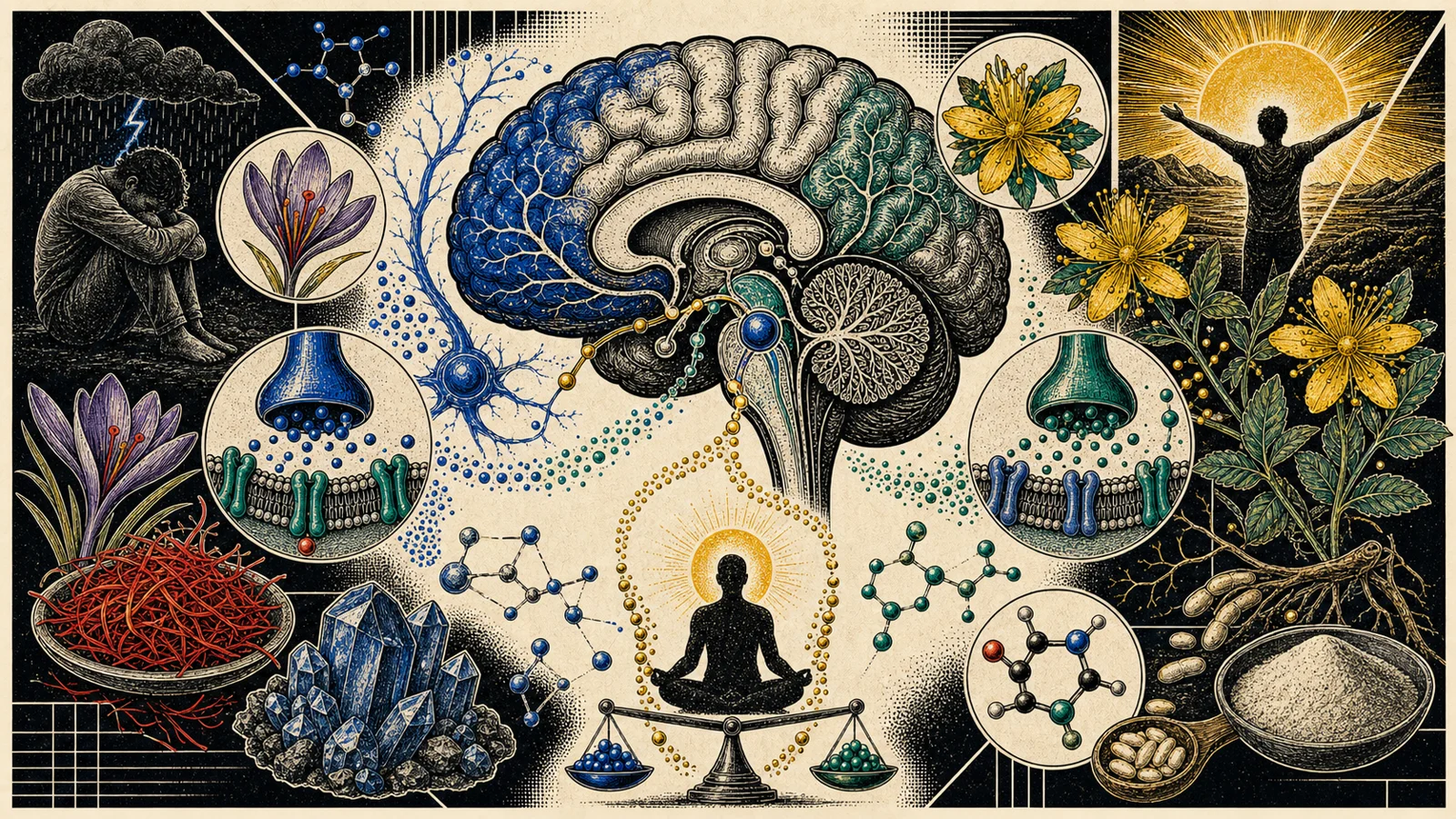
Saffron is one of the herbal compounds with the strongest human clinical evidence in the antidepressant field. Chrocoside and safranal components inhibit serotonin and dopamine reuptake; Its mechanism of action is similar to SSRIs. A meta-analysis (Hausenblas et al., 2013) found that 30 mg/day saffron showed efficacy superior to placebo and comparable to an SSRI in mild-to-moderate depression. Those using antidepressants should evaluate with their physician.
St. John's wort (Hypericum perforatum)
St. John's wortis the herb with the most comprehensive clinical evidence for mild-to-moderate depression – a Cochrane review found significant efficacy in comparisons of placebo and some antidepressants in 29 studies. The hyperphoric component multiple inhibits the reuptake of serotonin, dopamine, and norepinephrine. Critical notice: It creates serious interactions with antidepressants, birth control pills, warfarin and many drugs due to CYP3A4 induction. Those who use medication should definitely consult a physician.
5-HTP (5-Hydroxytryptophan)
5-HTP, a precursor in the conversion pathway of L-tryptophan to serotonin, crosses the blood-brain barrier and directly increases central serotonin synthesis. There are studies showing positive effects on mood, sleep and anxiety. Concomitant use with SSRIs or MAOIs due to the risk of serotonin syndrome is contraindicated. Long-term use requires special attention.
L-Theanine
L-Theaninereduces acute anxiety through GABA activation and NMDA antagonism. Since it does not interfere with the serotonin system, it is a safe combination candidate for those using antidepressants. At a dose of 200–400 mg, it has a sedating but not dizzying effect that lasts for hours. Studies provide strong evidence, especially for stress-induced anxiety and sleep difficulties.
Magnesium (Especially Glycinат / L-Threonate)
magnesiumis a natural antagonist of the NMDA receptor; deficiency is strongly associated with anxiety and depressive symptoms. The majority of the adult population in Türkiye receives insufficient magnesium. Magnesium glycinate and L-Threonate forms provide more effective passage to the central nervous system. Magnesium taken before bed supports both anxiety and sleep quality.
Omega-3 (EPA Weighted)
Omega-3For its effect on depression, the EPA component is critical – not DHA. EPA reduces neuroinflammation and increases serotonin receptor sensitivity. Meta-analyses show that formulas containing at least 1 g/day EPA significantly improve depressive symptoms. Fish oils with an EPA/DHA ratio of 2:1 or higher should be preferred.
Which Approach in Which Situation?
| Symptom Profile | Primary Support | complementary |
|---|---|---|
| Slightly depressed mood, loss of motivation | Saffron 30 mg/day | Omega-3 (EPA), exercise |
| Anxiety, tension, difficulty sleeping | Magnesium + L-Theanine (night) | Ashwagandha (HPA support) |
| Seasonal depression (winter periods) | vitamin D + omega-3 | Saffron, morning light therapy |
| Stress-induced mood disorder | Ashwagandha + rhodiola | L-Theanine, magnesium |
Lifestyle: Strong Foundations from Medicine
- Aerobic exercise: Meta-analyses have shown antidepressant-level effectiveness; 3× 30 minutes a week is enough
- Sleep hygiene: Sleep disturbance and depression/anxiety are bidirectionally related; Sleep disturbance increases resistance to treatment
- Social link: Isolation multiplies the risk of depression; social support has a neuroprotective effect
- sunlight: Serotonin synthesis is light dependent; 20–30 minutes of natural light exposure in the morning makes a significant difference
Sources
- Hausenblas HA, et al. (2013). Saffron (Crocus sativus L.) and major depressive disorder: A meta-analysis of randomized clinical trials. Journal of Integrative Medicine, 11(6), 377–383. PubMed · PMID 24299602
- Linde K, et al. (2008). St John's Wort for major depression. Cochrane Database of Systematic Reviews, (4). Search PubMed (match unverified)
- Sublette ME, et al. (2011). Meta-analysis of the effects of eicosapentaenoic acid (EPA) in clinical trials in depression. Journal of Clinical Psychiatry, 72(12), 1577–1584. PubMed · PMID 21939614
- Boyle NB, et al. (2017). The effects of magnesium supplementation on subjective anxiety and stress. Nutrients, 9(5), 429. Search PubMed (match unverified)
Link verification checks the identity of the publication; it does not constitute independent expert review of clinical claims. Our evidence and source methodology · Source directory
Frequently Asked Questions
No in clinically diagnosed moderate to severe depression or anxiety disorder. Natural supports cannot replace treatment under the supervision of a psychiatrist. They may be effective alone for mild symptoms; however, it is safe to make this decision with a clinician.
It is necessary to be careful. Substances such as L-Theanine and magnesium are generally safe combinations; However, 5-HTP, St. John's wort and saffron may interact with SSRI/SNRI. Do not add anything without informing your physician.
Both are herbal compounds that show antidepressant activity; However, St. John's wort has the potential to create many more and extensive drug interactions. For those who do not use medication, both can be evaluated; For those taking medications, saffron is generally the safer option.
L-Theanine and magnesium may act acutely (within hours). For saffron and St. John's wort, 4–6 weeks of regular use is required. The effect of omega-3 on mood is seen in 8–12 weeks. Patience and consistency are the main factors that determine the success of these supports.


