Contents 5 dk okuma
Important Note
This page is not medical advice. While the potential benefits of L-Theanine are supported by research, it should not be used to treat any health problems. Consult a healthcare professional.
What is L-Theanine?
L-Theanine (γ-glutamylethylamide), tea plant Camellia sinensis It is an amino acid found naturally in the leaves of vineyard and is structurally similar to glutamic acid. L-Theanine, isolated from tea extract in Japan in 1949, is found in approximately 20–50 mg in a cup of green tea; this amount can reach 70–80 mg in quality Japanese matcha tea.
L-Theanine's physiological properties distinguish it from other amino acids: it crosses the blood-brain barrier via active transport and reaches the brain tissue, initiating neurochemical effects. The distinctive feeling of “calm alertness” that green tea creates is largely due to L-Theanine; This drink, which contains caffeine but creates a feeling of clarity rather than fatigue, gains this quality with the regulating effect of L-Theanine on caffeine.
L-Theanine used as a dietary supplement may be of synthetic or tea extract origin; The biological activity of both forms is considered equivalent. It has GRAS (Generally Recognized as Safe) status by the FDA and its safety profile is extremely good.
Mechanism of Effect

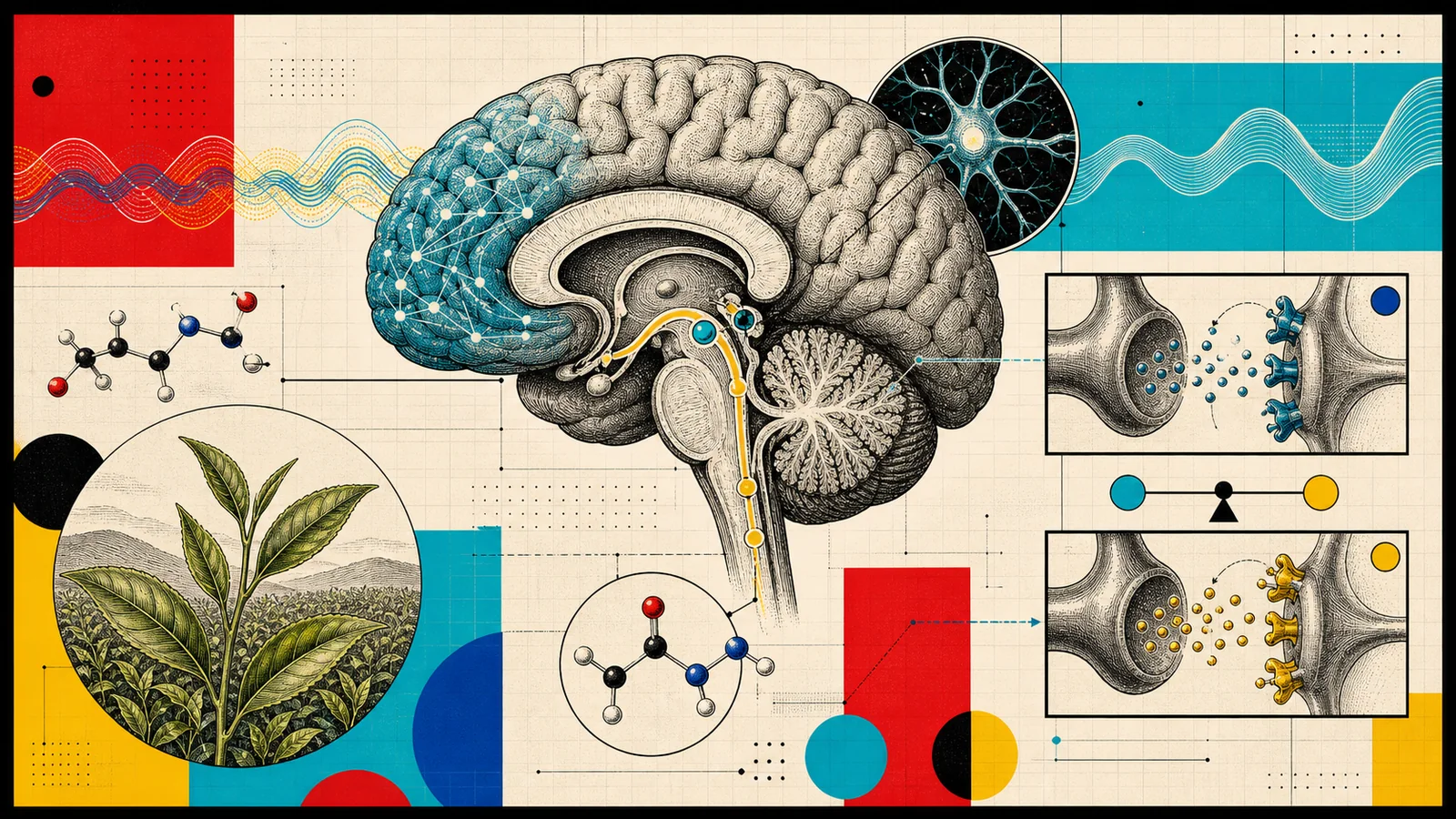
L-Theanine exhibits a multi-target effect profile. Its basic mechanisms can be listed as follows:
Alpha brain waves (8–12 Hz): The best documented and most characteristic effect of L-Theanine is that it measurably increases alpha brain waves on the EEG. Alpha waves represent the alert but calm and focused mental state; It intensifies during meditation, creative thinking and deep concentration. L-Theanine significantly enhances these waves in just 40 minutes.
GABA enhancing effect: L-Theanine increases the brain concentration of the inhibitory neurotransmitter GABA. This effect explains its anxiolytic (anxiety-reducing) feature and prevents overstimulation of the central nervous system.
Glutamate antagonism: L-Theanine partially modulates glutamate activity via NMDA receptors. While excessive activation of glutamate can create neurotoxicity, L-Theanine balances this system; This effect explains its neuroprotective feature.
Caffeine antagonism: While L-Theanine does not affect the mechanism by which caffeine blocks adenosine receptors, it reduces the blood vessel narrowing (vasoconstriction) caused by caffeine. This effect prevents caffeine-related headaches. It also softens the "sharpness" of caffeine without completely eliminating its stimulating effect, resulting in clear focus without jitters or palpitations.
Caffeine + L-Theanine: The Most Popular Nootropic Combination
The combination of caffeine and L-Theanine is the synergistic combination with the most robust evidence base in the world of nootropics. This duo has been studied many times in brain performance research and has produced reproducible positive results.
Recommended rate 2:1 (theanine:caffeine) The most common practical dose is 200 mg L-Theanine + 100 mg caffeine. This ratio is empirically recognized as the formula that works best for maximizing the stimulant effect of caffeine while minimizing side effects such as anxiety, palpitations and tremors.
The functioning of the synergy can be summarized as follows: while caffeine blocks adenosine receptors and increases alertness and attention, L-Theanine transforms this arousal into a calm and controlled focus through alpha wave activation and GABA increase. EEG studies have shown that the combination produces higher attention and processing speed scores than using caffeine alone or theanine alone.
Clinical Evidence
Kimura et al. (2007) found that 200 mg of L-Theanine significantly increased alpha waves in the occipital and parietal cortex in anxiety-prone individuals; documented with EEG that this effect started within 40 minutes and lasted for hours.
Nobre et al. (2008) showed that even consumption of tea containing 50 mg L-Theanine improved mental alertness and reaction time; indicated that low doses may also be functional.
Owen et al. (2008), in a double-blind crossover study examining the combination of 50 mg caffeine + 100 mg L-Theanine, reported that this combination provided improvements in speed and accuracy in attention-switching tasks compared to both caffeine alone and placebo. This study remains the most comprehensive study systematically demonstrating the synergistic superiority of the combination.
Dosage Protocol
| Purpose | Dose | Timing | combination |
|---|---|---|---|
| Daily calmness/anxiety reduction | 100–200 mg | any time | Alone or with tea |
| Focus combination with caffeine | 200 mg theanine | In the morning or before noon | with 100 mg caffeine |
| Sleep quality support | 200–400 mg | 30 minutes before bed | Synergy with magnesium is possible |
Form selection: L-Theanine is available in capsule, tablet or powder form; The bioavailability of all forms is similar. The purity of L-form produced through fermentation, known under the brand name Suntheanine, is considered to be of the highest standard; This form has been used in many studies. The powder form provides flexibility and can be added to morning coffee or matcha.
⚠ Caffeine Combination Warning
While the caffeine + L-Theanine combination is quite safe, it is not suitable for individuals who do not tolerate caffeine. Caffeinated combination should be avoided due to caffeine restriction during pregnancy and breastfeeding. There are no known significant contraindications or drug interactions when L-Theanine is used alone. Caution should be exercised in those using blood pressure lowering medications.
Safety and Side Effects
L-Theanine is an extremely safe compound that humanity has consumed through tea for thousands of years and has been granted GRAS status by the FDA. No serious side effects have been reported at supplement doses (100–400 mg). Rare, mild side effects include:
- Mild headache (extremely rare) at very high doses (600 mg+)
- Slight decrease in blood pressure (caution for those with low blood pressure)
- Extreme sedation or mild drowsiness (dose dependent; not observed in the majority)
Long-term safety studies are backed by thousands of years of human experience in the form of continued tea consumption. In supplement form, no adverse effects were reported in 12-week clinical studies. It should be noted that consumption of L-Theanine from tea alone during pregnancy (approximately 1–2 cups per day) is generally considered safe, but there is insufficient data on high-dose supplement forms.
Sources
- Kimura K, et al. (2007). L-Theanine reduces psychological and physiological stress responses. Biological Psychology, 74(1), 39–45. PubMed · PMID 16930802
- Nobre AC, et al. (2008). L-Theanine, a natural constituent in tea, and its effect on mental state. Asia Pacific Journal of Clinical Nutrition, 17(S1), 167–168. PubMed · PMID 18296328
- Owen GN, et al. (2008). The combined effects of L-Theanine and caffeine on cognitive performance and mood. Nutritional Neuroscience, 11(4), 193–198. PubMed · PMID 18681988
- Ritsner MS, et al. (2011). L-Theanine relieves positive, activation, and anxiety symptoms in patients with schizophrenia and schizoaffective disorder. Journal of Clinical Psychiatry, 72(1), 34–42. Search PubMed (match unverified)
- Lyon MR, et al. (2011). The effects of L-Theanine (Suntheanine) on objective sleep quality in boys with attention deficit hyperactivity disorder (ADHD). Alternative Medicine Review, 16(4), 348–354. Search PubMed (match unverified)
Link verification checks the identity of the publication; it does not constitute independent expert review of clinical claims. Our evidence and source methodology · Source directory
Frequently Asked Questions
L-Theanine is an amino acid found in green tea. By increasing alpha brain waves, it provides a state of calm alertness and focus without causing anxiety. It reduces stress by increasing GABA levels, balances the negative side effects of caffeine and supports sleep quality.
For general use, 100–200 mg per day is sufficient. When used with caffeine, a 2:1 ratio is recommended; i.e. 200 mg of L-Theanine versus 100 mg of caffeine. For sleep quality, 200–400 mg can be taken 30 minutes before bedtime. Doses above 400 mg/day have generally not been studied in clinical studies.
L-Theanine has GRAS (Generally Safe) status by the FDA and has an extremely low side effect profile. In very rare cases, high doses (over 600 mg) may cause mild headache or low blood pressure. People with low blood pressure should be careful; High dose forms of supplements should be avoided during pregnancy.
Yes, L-Theanine is a completely legal dietary supplement in Türkiye. It does not require a prescription. It is available from health stores, vitamin stores and online supplement sellers. Products of international brands can also be ordered by cargo to Türkiye. When purchasing, it is recommended to choose standardized quality forms such as Suntheanine.
L-Theanine begins to work 30–60 minutes after oral intake. Alpha brain wave increase reaches a measurable level with EEG within 40 minutes. The duration of the effect is approximately 3–5 hours; Its half-life is approximately 1 hour. When taken with caffeine, the effect is felt more clearly and quickly.


