Contents 3 min read
Claim and source comparison
Abstracts of two controlled human experiments and one narrative review, drug labels and the relevant PKU-guideline section were read. Randomization was not verified in abstracts; the controlled-trial label does not assert nonrandomization. Not a full clinical review.
· Bounded source comparison; not a complete clinical review or independent medical endorsement.
Human controlled trial; randomization not verified
Shurtleff et al. (1994) examined working memory in the cold in 8 male volunteers using 150 mg/kg L-tyrosine and found benefit on one task measure. This small experiment does not validate a standard 500–2000 mg dose for healthy people or benefit under all stress conditions.
Limited to eight men and one cold-task protocol; no task effect was seen at 22 °C. The 150 mg/kg research amount cannot become a standard daily dose. The accessed abstract did not verify randomization, so no RCT label was assigned.
Source 1 · Abstract read
Human controlled trial; randomization not verified
Neri et al. (1995) compared a split 150 mg/kg L-tyrosine amount with placebo under double blinding during one night of sleep loss. Benefits on selected psychomotor and vigilance tasks lasted approximately three hours.
A three-hour task difference is not plasma half-life, a sleep substitute or personal timing. The accessed abstract does not verify randomization; this experiment does not establish everyday performance, effects under all stressors or long-term safety.
Source 2 · Abstract read
Narrative review
The Jongkees et al. (2015) narrative review describes variable L-tyrosine findings and possible benefits related to short-term stress or cognitive demands. Potential for clinical disease treatment and physical exercise was judged more limited.
This is a narrative review, not a pooled-effect meta-analysis or oral comparison with NALT. Being a biochemical precursor does not guarantee increased dopamine or clinical benefit for everyone.
Source 4 · Abstract read
Official safety summary
The phenelzine label explicitly lists L-tyrosine among substances that should not be taken together, with a hypertensive-crisis warning. The carbidopa/levodopa label describes competition with certain amino acids for intestinal transport and reduced absorption with high-protein diets.
These labels concern the named medicines, not equal evidence for every MAOI, supplement dose or NALT. Do not change prescribed medication; review combined use with a doctor or pharmacist. This information does not generate personal medication times.
2026-11-11 correction: Cold and sleep-loss experiments were bounded to their conditions; narrative review was distinguished from systematic review. The generic half-life and dose unverified in the sources read were removed. Phenelzine contraindication and levodopa absorption warnings were linked to drug labels; NALT-superiority advice was removed.
What is L-Tyrosine?
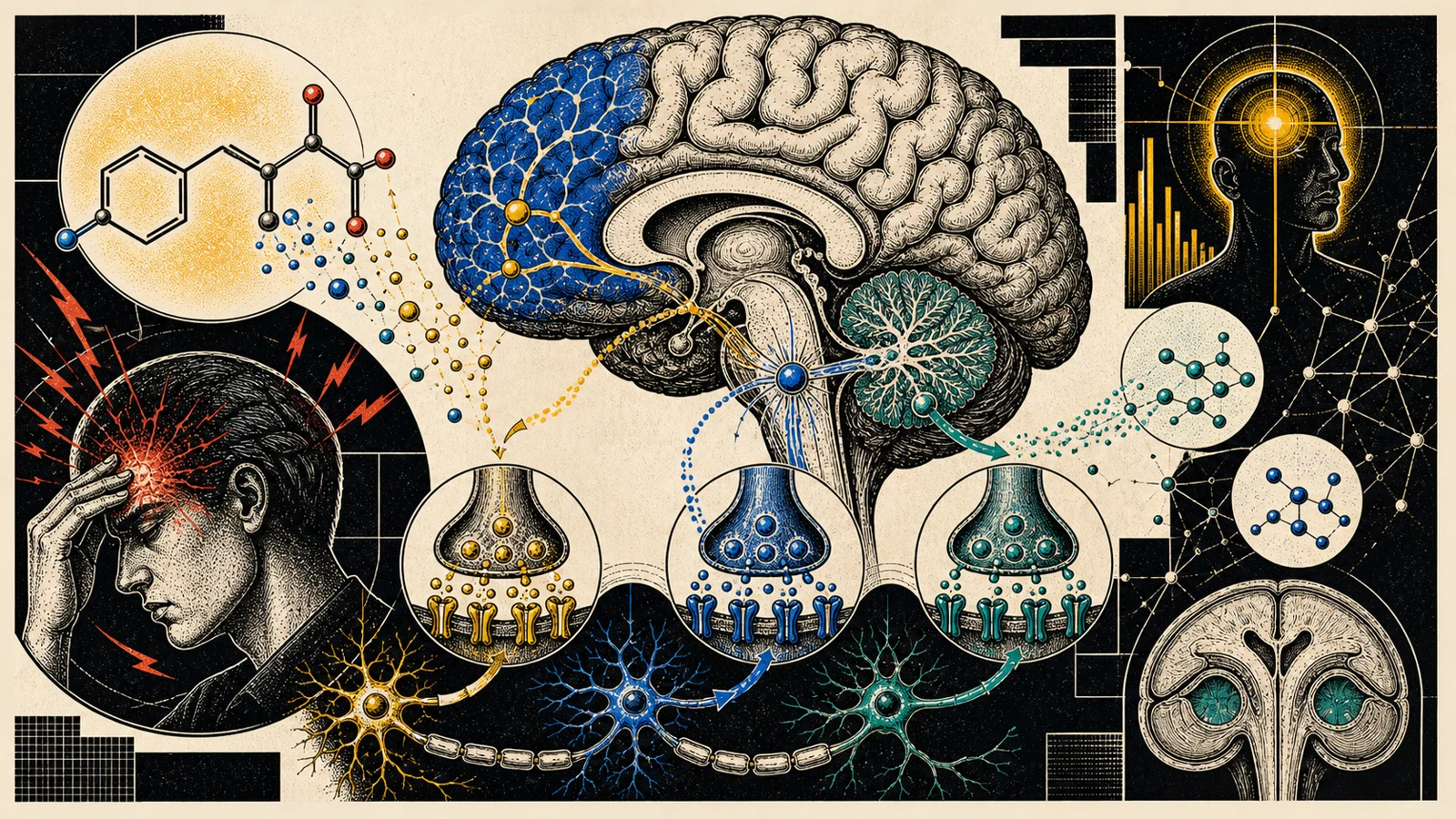
L-Tyrosine is an amino acid used in catecholamine synthesis. Small, variable human experiments studied selected tasks under stress; they do not establish general cognitive enhancement, a personal dose or equivalence with NALT.
Clinical Evidence
Shurtleff et al. (1994) examined working memory in the cold in 8 male volunteers using 150 mg/kg L-tyrosine and found benefit on one task measure. This small experiment does not validate a standard 500–2000 mg dose for healthy people or benefit under all stress conditions.
Limited to eight men and one cold-task protocol; no task effect was seen at 22 °C. The 150 mg/kg research amount cannot become a standard daily dose. The accessed abstract did not verify randomization, so no RCT label was assigned.
Neri et al. (1995) compared a split 150 mg/kg L-tyrosine amount with placebo under double blinding during one night of sleep loss. Benefits on selected psychomotor and vigilance tasks lasted approximately three hours.
A three-hour task difference is not plasma half-life, a sleep substitute or personal timing. The accessed abstract does not verify randomization; this experiment does not establish everyday performance, effects under all stressors or long-term safety.
The Jongkees et al. (2015) narrative review describes variable L-tyrosine findings and possible benefits related to short-term stress or cognitive demands. Potential for clinical disease treatment and physical exercise was judged more limited.
This is a narrative review, not a pooled-effect meta-analysis or oral comparison with NALT. Being a biochemical precursor does not guarantee increased dopamine or clinical benefit for everyone.
L-Tyrosine vs N-Acetyl-L-Tyrosine (NALT)
The Jongkees et al. (2015) review concerns L-tyrosine supplementation. The abstract read does not establish oral NALT cognitive superiority, faster effects or use at the same dose as L-tyrosine.
A parent-compound experiment cannot automatically establish clinical efficacy of its acetylated derivative. This limited reading does not claim all NALT research is absent; distinguish a research question from a demonstrated result.
Dose information and research limits
Dose information and research limits
This dose information describes research or product context; it is not a personal prescription, established safe upper limit or efficacy guarantee for healthy people. Extracts and different formulations should not be treated as equivalent milligram for milligram.
Safety and Side Effects
The phenelzine label explicitly lists L-tyrosine among substances that should not be taken together, with a hypertensive-crisis warning. The carbidopa/levodopa label describes competition with certain amino acids for intestinal transport and reduced absorption with high-protein diets.
These labels concern the named medicines, not equal evidence for every MAOI, supplement dose or NALT. Do not change prescribed medication; review combined use with a doctor or pharmacist. This information does not generate personal medication times.
Tyrosine is not prohibited in PKU; reduced production from phenylalanine can make it part of specialist-managed nutrition. Do not self-adjust extra tyrosine doses; it does not replace standard PKU treatment.
Related research and reading
These links show explicit editorial topic connections; they do not confirm a mechanism, efficacy or the safety of combined use. News dates refer to the source or event.
Educational guides
- Dopamine and Motivation: Limits of Nootropic Evidence
Dopamine contributes to motivation; L-tyrosine and Mucuna studies do not establish general motivation gains or a safe dopamine protocol for healthy people.
- Caffeine and L-Theanine: Attention Studies and Their Limits
Small studies have examined some attention measures; a universal ideal ratio, prevention of caffeine side effects or safe use for everyone has not been established.
- Athlete Brain Performance: Supplement Evidence and Limits
Physical performance findings are not the same as cognitive benefits. Creatine, L-tyrosine, Rhodiola and caffeine studies are considered with their populations and conditions.
Sources
- Shurtleff D, et al. (1994). Tyrosine reverses a cold-induced working memory deficit in humans. Pharmacology Biochemistry and Behavior, 47(4), 935–941. PubMed · PMID 8029265
- Neri DF, et al. (1995). The effects of tyrosine on cognitive performance during extended wakefulness. Aviation, Space, and Environmental Medicine, 66(4), 313–319. PubMed · PMID 7794222
- Deijen JB, Orlebeke JF. (1994). Effect of tyrosine on cognitive function and blood pressure under stress. Brain Research Bulletin, 33(3), 319–323. PubMed · PMID 8293316
- Jongkees BJ, et al. (2015). Effect of tyrosine supplementation on clinical and healthy populations under stress or cognitive demands--A review. Journal of Psychiatric Research, 70, 50–57. PubMed · PMID 26424423
- van Wegberg AMJ, et al. (2017). The complete European guidelines on phenylketonuria: diagnosis and treatment. Orphanet Journal of Rare Diseases, 12(1), 162. https://doi.org/10.1186/s13023-017-0685-2 PubMed · PMID 29025426
- DailyMed. Phenelzine sulfate: US prescribing information. https://dailymed.nlm.nih.gov/dailymed/drugInfo.cfm?setid=fa041652-fdde-4794-a8d2-279dd309e075 DailyMed / US National Library of Medicine
- DailyMed. Carbidopa and levodopa: US prescribing information. https://dailymed.nlm.nih.gov/dailymed/drugInfo.cfm?setid=3f6d393e-ac84-4a3c-a837-199d1ec71fd2 DailyMed / US National Library of Medicine
Link verification checks the identity of the publication; it does not constitute independent expert review of clinical claims. Our evidence and source methodology · Source directory
Frequently Asked Questions
L-Tyrosine is an amino acid used in catecholamine synthesis. Small, variable human experiments studied selected tasks under stress; they do not establish general cognitive enhancement, a personal dose or equivalence with NALT.
Shurtleff et al. (1994) examined working memory in the cold in 8 male volunteers using 150 mg/kg L-tyrosine and found benefit on one task measure. This small experiment does not validate a standard 500–2000 mg dose for healthy people or benefit under all stress conditions.
The Jongkees et al. (2015) review concerns L-tyrosine supplementation. The abstract read does not establish oral NALT cognitive superiority, faster effects or use at the same dose as L-tyrosine.
A three-hour task difference is not plasma half-life, a sleep substitute or personal timing. The accessed abstract does not verify randomization; this experiment does not establish everyday performance, effects under all stressors or long-term safety.


