Contents 4 dk okuma
Important Note
This page is not medical advice. Mucuna pruriens has strong pharmacological effects and poses a risk of serious interactions, especially for individuals using medications. Consult a healthcare professional before starting any supplements.
What is Mucuna Pruriens?
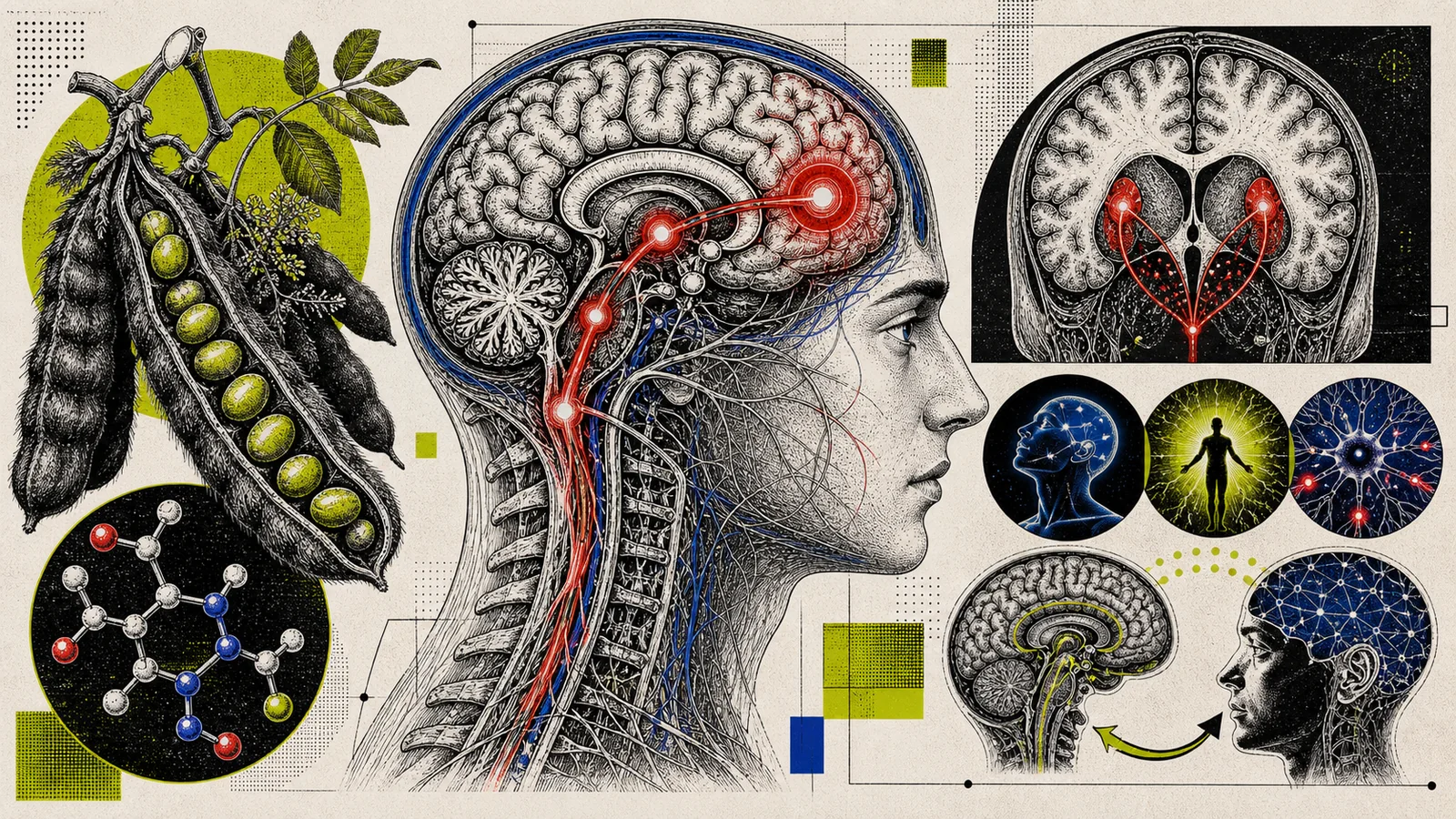
Mucuna pruriens is a tropical legume plant known as "Atmagupta" or "Kapikachhu" in Indian traditional medicine (Ayurveda). It grows naturally in the temperate regions of India, Africa and the Caribbean. It has been used in Ayurveda for thousands of years for nervous system support, male fertility and vitality.
The seeds of the plant contain dopamine, a natural amino acid that the brain converts into dopamine. L-DOPA (levodopa) It is extremely rich in terms of The L-DOPA ratio in raw seeds varies between approximately 3 and 6 percent of dry weight, depending on genotype; In commercial standardized extracts, it is commonly standardized to 15 percent (higher in some products). This feature makes Mucuna a unique natural dopaminergic agent.
Modern research confirms Mucuna's potential to relieve Parkinson's disease symptoms, support male reproductive health, and improve mood and motivation in healthy individuals.
Mechanism of Effect

Primary mechanism of action of Mucuna L-DOPA based on its content. L-DOPA is the only dopamine precursor that can freely cross the blood-brain barrier (BBB) and is converted to dopamine within the brain; dopamine itself cannot cross this barrier. This pharmacokinetic property explains the effects of Mucuna on the nervous system.
| Compound/Target | Impact | Conclusion |
|---|---|---|
| L-DOPA | Dopamine synthesis (passes BBB) | Dopamine levels increase |
| Trace tryptamine alkaloids (disputed) | Possible monoaminergic effects | Possible contribution to mood |
| Levodopa → Dopamine | Catecholamine synthesis | Motivation, movement control |
| prolactin inhibition | D2 receptor activation | Testosterone increase |
⚠ Pharmacological Potency - Drug Interaction Warning
Since Mucuna contains a direct dopamine precursor, it may have serious pharmacodynamic interactions with Parkinson's drugs (Carbidopa/Levodopa combinations). In addition, concomitant use with MAO inhibitors, antipsychotics and other dopaminergic agents may be dangerous. Individuals using any medication should NEVER start Mucuna supplements without obtaining doctor's approval.
Clinical Evidence
Clinical research on Mucuna pruriens focuses on two main areas: Parkinson's disease and male fertility.
For Parkinson's: Katzenschlager et al. (2004), natural Mucuna L-DOPA and synthetic L-DOPA/Carbidopa combination were given comparatively to 8 Parkinson's patients. Mucuna extract showed faster onset of action and fewer dyskinesia (involuntary movement) side effects compared to the synthetic form. Researchers have suggested that other bioactive compounds in Mucuna positively modulate the effect of L-DOPA on the nervous system.
For fertility and testosterone: In three randomized studies, Mucuna supplementation was found to significantly increase sperm count, motility, and testosterone levels in infertile men. This effect is explained by prolactin inhibition and regulation of the hypothalamic-pituitary-gonadal axis.
For healthy individuals: Although effects on mood and motivation have a strong theoretical basis, comprehensive randomized controlled studies in healthy young adults are limited. Most of the available clinical data are obtained from patients with Parkinson's disease or infertile men.
Dosage Protocol
Dosage for Mucuna pruriens varies significantly depending on the L-DOPA standardization percentage of the product used. The following values are based on standardized extracts containing 15 percent L-DOPA:
| Intended Use | Dose (15% L-DOPA standardized) | Amount of L-DOPA |
|---|---|---|
| General mood support | 300–500 mg/day | 45–75 mg L-DOPA |
| Fertility/testosterone | 5000 mg/day (research dose) | ~750 mg L-DOPA |
| Parkinson's (only under doctor's supervision) | individualized | Variable |
Product selection: Avoid unstandardized raw powder products; Choose standardized extracts with a clearly stated L-DOPA percentage. Taking it in the morning or at noon, preferably with food, reduces the risk of nausea. Night use may negatively affect sleep quality.
Safety and Side Effects
Mucuna pruriens has a different safety profile than other plant-based nootropics due to its high L-DOPA content. It is an agent that requires careful use.
- Common side effects: Nausea and stomach upset (especially with high doses or on an empty stomach); dizziness; orthostatic hypotension (sudden drop in blood pressure upon standing up).
- Long-term use risks: The risk of dyskinesia (involuntary movements) may be increased in Parkinson's patients. Chronic high dose use may lead to dopamine receptor desensitization.
- At very high doses: Risk of mania-like symptoms, hallucinations and psychosis.
Contraindications:
- MAO inhibitors (risk of serious hypertensive crisis)
- Other dopaminergic drugs (Carbidopa/Levodopa combinations)
- Schizophrenia and other psychotic disorders
- Bipolar disorder (can trigger mania)
- Pregnancy and breastfeeding period
Sources
- Katzenschlager R, et al. (2004). Mucuna pruriens in Parkinson's disease: a double blind clinical and pharmacological study. Journal of Neurology, Neurosurgery & Psychiatry, 75(12), 1672–1677. PubMed · PMID 15548480
- Shukla KK, et al. (2010). Mucuna pruriens improves male fertility by its action on the hypothalamus-pituitary-gonadal axis. Fertility and Sterility, 92(6), 1934–1940. Search PubMed (match unverified)
- Lieu CA, et al. (2010). A water extract of Mucuna pruriens provides long-term amelioration of parkinsonism with reduced risk for dyskinesias. Parkinsonism & Related Disorders, 16(7), 458–465. PubMed · PMID 20570206
- Manyam BV, et al. (2004). Nongenotoxic and noncytotoxic effects of the anti-Parkinson drug HP-200 (Mucuna pruriens) - a neurobiological study. Phytotherapy Research, 18(9), 706–712. Search PubMed (match unverified)
Link verification checks the identity of the publication; it does not constitute independent expert review of clinical claims. Our evidence and source methodology · Source directory
Frequently Asked Questions
Mucuna pruriens supports the brain's dopamine synthesis through the natural L-DOPA found in its seeds. In this way, it positively affects motivation, mood and movement coordination. Scientific studies have examined its use for reducing Parkinson's symptoms, improving male fertility and testosterone levels, and general dopaminergic support.
For general mood and motivation support, 300-500 mg daily in standardized extracts containing 15 percent L-DOPA is an adequate starting dose. In studies, doses as high as 5000 mg per day have been used for male fertility. The L-DOPA percentage of the product should be clearly stated; Unstandardized raw powders should be avoided. It is recommended to take it with food to reduce the risk of nausea.
The most common side effects include nausea, upset stomach, and dizziness; these occur especially with high doses or use on an empty stomach. A drop in blood pressure (orthostatic hypotension) may occur when standing up suddenly. Dopamine receptor desensitization, dyskinesia, and rarely mania or hallucination-like symptoms have been reported with long-term or very high dose use.
Mucuna pruriens is not on any drug or controlled substance list in Türkiye and its sale as a nutritional supplement is legal. Products of international supplement brands are available through e-commerce platforms and some health product stores. However, choosing reliably sourced products with 15 percent L-DOPA standardization is critical; Products whose L-DOPA content is not stated on the label should be avoided.
When used in a single dose, the effect can be felt within 30-90 minutes, thanks to its L-DOPA content; The plasma half-life of L-DOPA is approximately 1-2 hours. The effects on fertility and testosterone are generally observed within 4-8 weeks with regular use. Consistent, cyclical use (e.g. use 5 days, rest 2 days) is recommended for long-term benefits on mood and motivation.


