Contents 4 dk okuma
Important Note
This page is not medical advice. While the potential benefits of cordyceps supplements are supported by research, they should not be used to treat any health problems. Consult a healthcare professional.
What is Cordyceps?
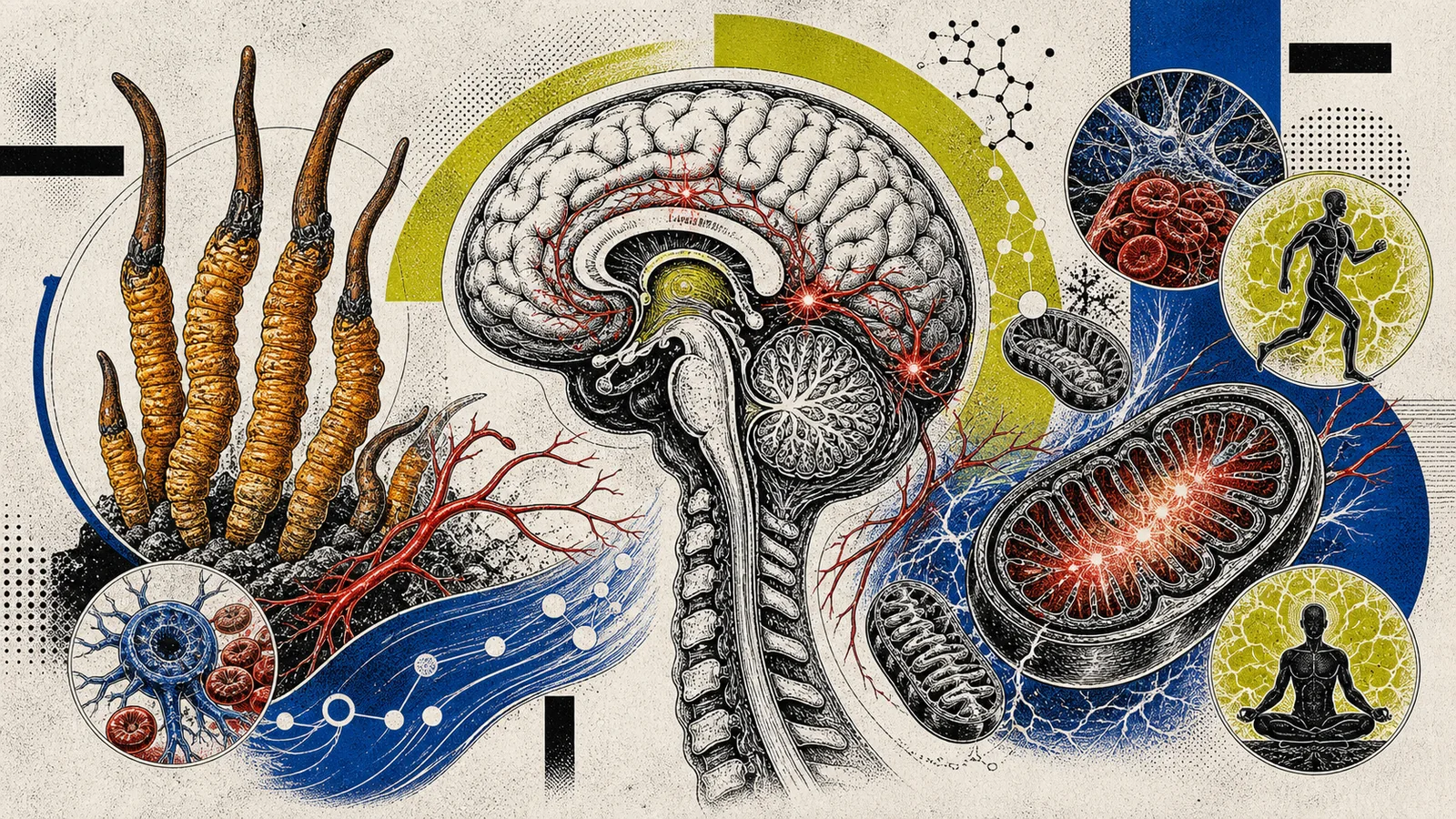
Cordyceps is a genus of medicinal mushrooms that grows in the mountains of the Tibetan Himalayas and China. It is known as "caterpillar fungus" in traditional Chinese medicine; It got this name because it grows as a parasite on insect larvae. It has been used for centuries by Tibetan shepherds and Chinese physicians against fatigue, sexual potency and longevity.
Two important species of the Cordyceps genus stand out in the supplement context: Cordyceps sinensisis a wild species that grows naturally in the Himalayas and the Tibetan plateau; It is extremely rare and expensive, with quality examples selling for hundreds of dollars per gram. Cordyceps militaris It is a species that can be grown under controlled conditions and is comparable to sinensis in terms of cordycepin and other active compounds; This type is used in the vast majority of research and commercial supplements.
Mechanism of Effect

Cordyceps acts through multiple mechanisms, affecting cellular energy production, oxygen use and the immune system. Principal active compound cordycepin (3'-deoxyadenosine) is a structural analogue of the adenosine molecule and interferes with cellular adenosine/nucleotide signaling and energy metabolism; However, the exact mechanism of its effect through these pathways has not yet been clearly elucidated.
| Compound/Mechanism | Impact | Conclusion |
|---|---|---|
| Cordycepin (3'-deoxyadenosine) | Adenosine analogue; interference with nucleotide signaling | Modulation of energy metabolism (mechanism not entirely clear) |
| Beta-glucans | Immune system modulation | Immune strengthening |
| adenosine | cAMP pathway activation | Bronchodilation, increased oxygen uptake |
| AMPK activation | metabolic sensor | Cellular energy efficiency |
| Antioxidant/anti-fatigue effects | Reduction of oxidative stress (animal data) | Increased fatigue resistance (theoretical) |
Clinical Evidence
Human research on cordyceps is more limited than animal studies, but there are promising results in the areas of sports performance and fatigue.
Hirsch et al. (2017) examined the effect of Cordyceps militaris extract on high-intensity exercise tolerance in 28 young and physically active individuals (mean age ~23) in a double-blind, placebo-controlled RCT. While there was no significant change in VO2max after one week of use, significant improvements in VO2max, time to fatigue and ventilation threshold were observed after three weeks of continuous use. Earnest et al. (2004) investigated the effects of Cordyceps sinensis supplementation on endurance performance in a study conducted on elite athletes; Improvement in time to fatigue has been reported. (Note: the results cannot be attributed solely to Cordyceps, as this commercial mixture does not contain Cordyceps.) Jia-Shi et al. (2008) showed that Cordyceps (CordyMax Cs-4) supplementation improved the cellular bioenergy (ATP/energy load) status in the liver.
⚠ Research Limitations
Human RCT studies on Cordyceps are limited in number and sample sizes are generally small. Although animal studies strongly support the mechanism, more comprehensive research is needed for long-term effectiveness in healthy athletes.
Dosage Protocol
Dosages for Cordyceps used in research and recommended in common practice vary depending on the intended use. Taking the supplement with food increases gastrointestinal tolerance.
| Intended Use | Dose | Timing |
|---|---|---|
| Energy/endurance | 1000–3000 mg/day | Pre-workout or in the morning |
| general health | 1000 mg/day | morning |
| sports performance | 3000–4500 mg/day | split doses |
Militaris or sinensis? Cordyceps militaris is the species that can be grown under controlled conditions, whose cordycepin content can be verified, and is used in the majority of research. Cordyceps sinensis is a species that is extremely rare in nature, has a very high price and is open to counterfeiting. Cordyceps militaris extract should be preferred when used for supplement purposes. Note the cordycepin content and beta-glucan percentage in standardized extracts.
Safety and Side Effects
Cordyceps is generally considered a very safe supplement. No serious side effects have been reported in current clinical studies. Rare undesirable effects:
- Mild gastrointestinal upset (rare at high doses)
- Nausea or heartburn (when taken on an empty stomach)
- Theoretical anticoagulant effect: users of blood thinners should be careful
Individuals with autoimmune diseases should consult a doctor before use due to its immune modulation effect. Interaction with those using immunosuppressive drugs is theoretically possible. Caution should be exercised in those with mushroom allergies.
Sources
- Hirsch KR, et al. (2017). Cordyceps militaris improves tolerance to high-intensity exercise after acute and chronic supplementation. Journal of Dietary Supplements, 14(1), 42–53. PubMed · PMID 27408987
- Earnest CP, et al. (2004). Effects of a commercial herbal-based formula on exercise performance in cyclists. Medicine and Science in Sports and Exercise, 36(3), 504–509. PubMed · PMID 15076794
- Jia-Shi Z, et al. (2008). CordyMax Cs-4 improves steady-state bioenergy status in mouse liver. Journal of Alternative and Complementary Medicine, 14(3), 289–296. Search PubMed (match unverified)
- Chen S, et al. (2010). Cordyceps sinensis and its fractions stimulate MA-10 mouse Leydig tumor cell steroidogenesis. Journal of Andrology, 31(2), 246–249. Search PubMed (match unverified)
Link verification checks the identity of the publication; it does not constitute independent expert review of clinical claims. Our evidence and source methodology · Source directory
Frequently Asked Questions
Cordyceps is an adaptogenic medicinal mushroom that increases ATP production, improves oxygen use efficiency and supports physical endurance. Energy increase, exercise performance, immune system support and fatigue reduction are the main purposes of use. It has been used in traditional Chinese medicine for centuries for fatigue, sexual health and general vitality.
1000 mg per day is recommended for general health support, 1000–3000 mg for energy and endurance, and 3000–4500 mg for sports performance in divided doses. Taking the supplement with food increases gastrointestinal tolerance. Standardized Cordyceps militaris extract should be preferred; Attention should be paid to cordycepin and beta-glucan content.
The effects of Cordyceps usually begin to be felt within 1–2 weeks of regular use. Some people may notice earlier changes in energy and stamina; however, 3–4 weeks of continuous use is usually required for measurable improvements such as VO2max and oxygen efficiency. The duration of effect may vary from individual to individual.
Cordyceps is generally considered a very safe supplement. Rare side effects may include mild gastrointestinal upset at high doses and nausea when taken on an empty stomach. Those with autoimmune diseases, those using immunosuppressive medications and those receiving blood thinning treatment should consult their doctor before use. Caution is recommended for those with mushroom allergies.
Cordyceps is a product that is legal to sell as a food supplement in Türkiye; There is no restriction or prohibited substance classification. It can be obtained from health markets, organic product sales points and reliable online supplement stores. When purchasing, it is important for quality to choose products that contain Cordyceps militaris extract, whose cordycepin and beta-glucan contents are stated on the label, and that have a third-party test certificate.


