Contents 3 dk okuma
Important Note
This page is not medical advice. It is strongly recommended that you measure your vitamin D level with a blood test and determine the supplement dose with a physician. Excess vitamin D (hypervitaminosis D) can lead to serious side effects.
What is Vitamin D3?
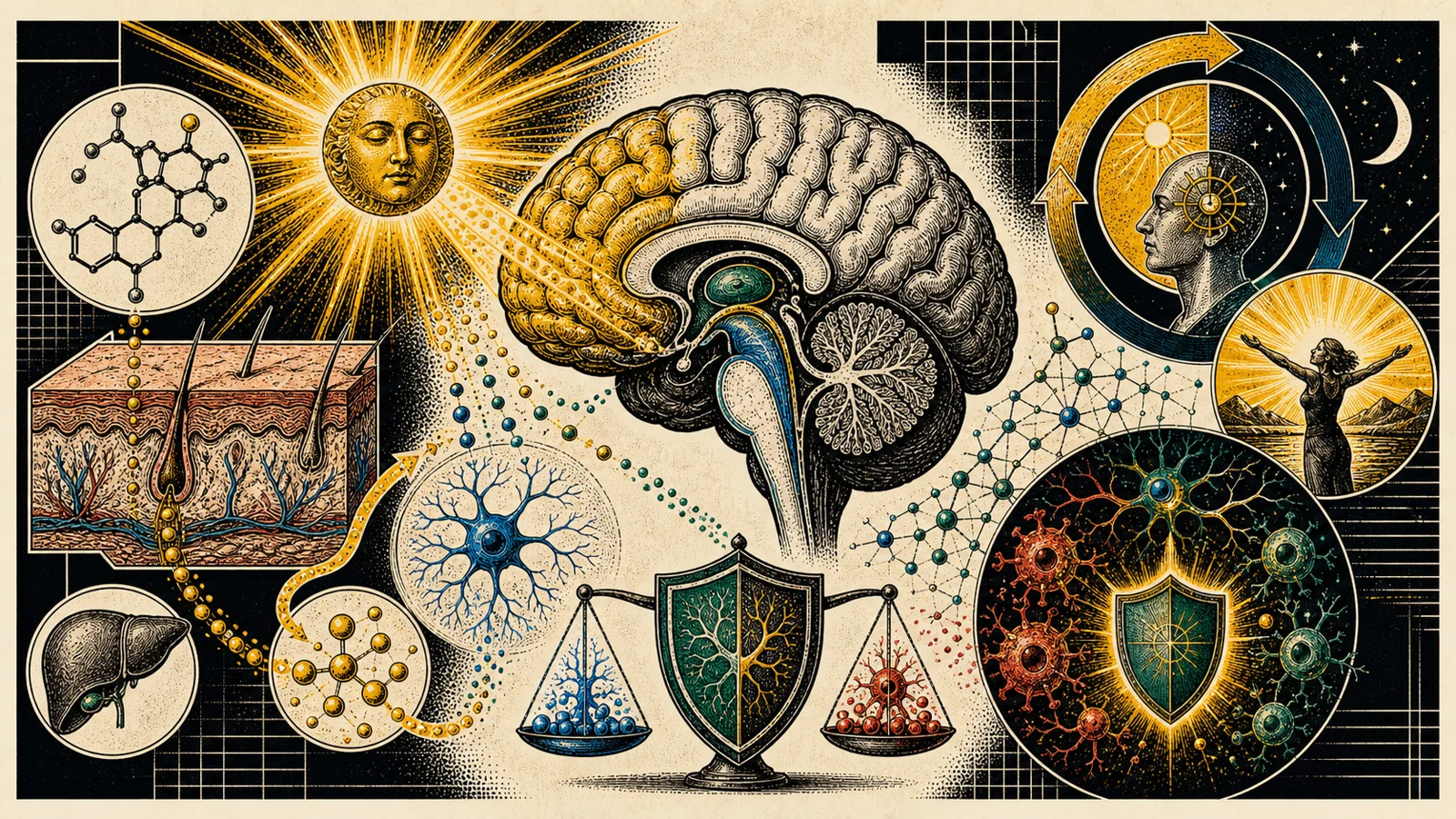
Vitamin D3 (cholecalciferol) is a fat-soluble vitamin synthesized when UVB radiation in sunlight converts skin cholesterol. It is converted to 25-hydroxyvitamin D3 (25-OH-D3) in the liver and then to the active form 1,25-dihydroxyvitamin D3 (calcitriol) in the kidney. Calcitriol in the cell nucleus Vitamin D receptors (VDR) binds and regulates gene expression.
The brain is an organ rich in vitamin D receptors and there is a dense VDR distribution in the prefrontal cortex, hippocampus, thalamus and brainstem. This distribution suggests that vitamin D plays a critical role in neurocognitive functions beyond just bone health.
Vitamin D Deficiency in Türkiye
Although Türkiye is a sunny country, vitamin D deficiency is at epidemic levels. Deficiency (<50 nmol/L) is detected in more than 70% of the population due to indoor lifestyle, use of sunscreen, air pollution and seasonal changes. During the winter months, there is not enough sunlight for vitamin D synthesis in Istanbul and the northern provinces for 3-5 months.
Mechanism of Effect

| mechanism | target | Neurocognitive Outcome |
|---|---|---|
| VDR activation | Tyrosine hydroxylase gene | Regulation of dopamine synthesis |
| VDR activation | Serotonin synthesis genes | Serotonin production support |
| Neurotrophin production | NGF and BDNF expression | Neuroplasticity and memory support |
| NF-κB inhibition | Pro-inflammatory cytokines | Neuroinflammation suppression |
| Glutamate homeostasis | Excitotoxicity protection | Increased neuronal survival |
Clinical Evidence
The relationship between vitamin D deficiency and depression is supported by strong epidemiological evidence. Interventional studies investigating deficiency replacement show that vitamin D supplementation can significantly reduce depressive symptoms and seasonal affective disorder symptoms. Cohort studies examining the relationship between Alzheimer's and Parkinson's risk and vitamin D levels found an inverse relationship.
⚠ Do Not Take High Doses Without a Blood Test
Vitamin D can dissolve in fat and accumulate in the body; Therefore, overdose can lead to permanent hypercalcemia (high calcium in the blood). Symptoms may include nausea, kidney stones, cardiac arrhythmia. For regular use above 4000 IU/day, 25-OH-D3 blood test and physician supervision are required.
Dosage Protocol
| Status | Dose | Timing |
|---|---|---|
| Mild deficiency protection (50–75 nmol/L) | 1000–2000 IU/day | Morning with fatty food |
| Moderate deficiency compensation (< 50 nmol/L) | 2000–4000 IU/day | Under physician supervision |
| Severe deficiency (< 25 nmol/L) | 5000 IU/day or loading dose | Must be under the guidance of a physician |
| Optimal protection (75–125 nmol/L) | 1000–2000 IU/day maintenance | with fatty food |
Combination with K2: Taking K2 (100–200 µg/day) in the form of MK-7 along with D3 helps direct calcium to bones and remove it from soft tissues; therefore, the K2 combination is recommended in high-dose D3 protocols.
Sources
- Holick MF. (2007). Vitamin D deficiency. New England Journal of Medicine, 357(3), 266–281. Search PubMed (match unverified)
- Shaffer JA, et al. (2014). Vitamin D supplementation for depressive symptoms: a systematic review and meta-analysis of randomized controlled trials. Psychosomatic Medicine, 76(3), 190–196. Search PubMed (match unverified)
- Eyles DW, et al. (2013). Vitamin D effects on brain development, adult brain function and the links between low levels of vitamin D and neuropsychiatric disease. Frontiers in Neuroendocrinology, 34(1), 47–64. PubMed · PMID 22796576
- Llewellyn DJ, et al. (2010). Vitamin D and risk of cognitive decline in elderly persons. Archives of Internal Medicine, 170(13), 1135–1141. PubMed · PMID 20625021
Link verification checks the identity of the publication; it does not constitute independent expert review of clinical claims. Our evidence and source methodology · Source directory
Frequently Asked Questions
The brain is rich in vitamin D receptors (VDR). vitamin D; It regulates dopamine and serotonin synthesis, suppresses neuroinflammation, supports BDNF production and provides neuronal protection. Deficiency is strongly associated with depression, cognitive decline, and risk of neurodegenerative disease.
First of all, we recommend that you have a 25-OH-D3 blood test. In case of mild deficiency (50–75 nmol/L) 1000–2000 IU/day is usually appropriate. Physician supervision is required for doses above 4000 IU/day. Take D3 with a fatty meal - absorption increases because it is fat-soluble.
D3 increases calcium absorption; K2 (especially the MK-7 form) ensures that this calcium is directed to the bones and removed from the arteries. If K2 is not combined with high-dose D3 protocols, calcium may accumulate in soft tissues.
Despite access to sufficient sunlight, factors such as indoor lifestyle, sunscreen, air pollution, dark skin (melanin synthesis effect) and winter season (insufficient UVB angle) significantly restrict vitamin D synthesis. It is estimated that more than 70% of the population is diagnosed with deficiency.


