Contents 5 dk okuma
Important Note
This page is not medical advice. Although the potential benefits of curcumin are supported by research, it should not be used to treat any health problems. Consult a healthcare professional.
What is Curcumin?
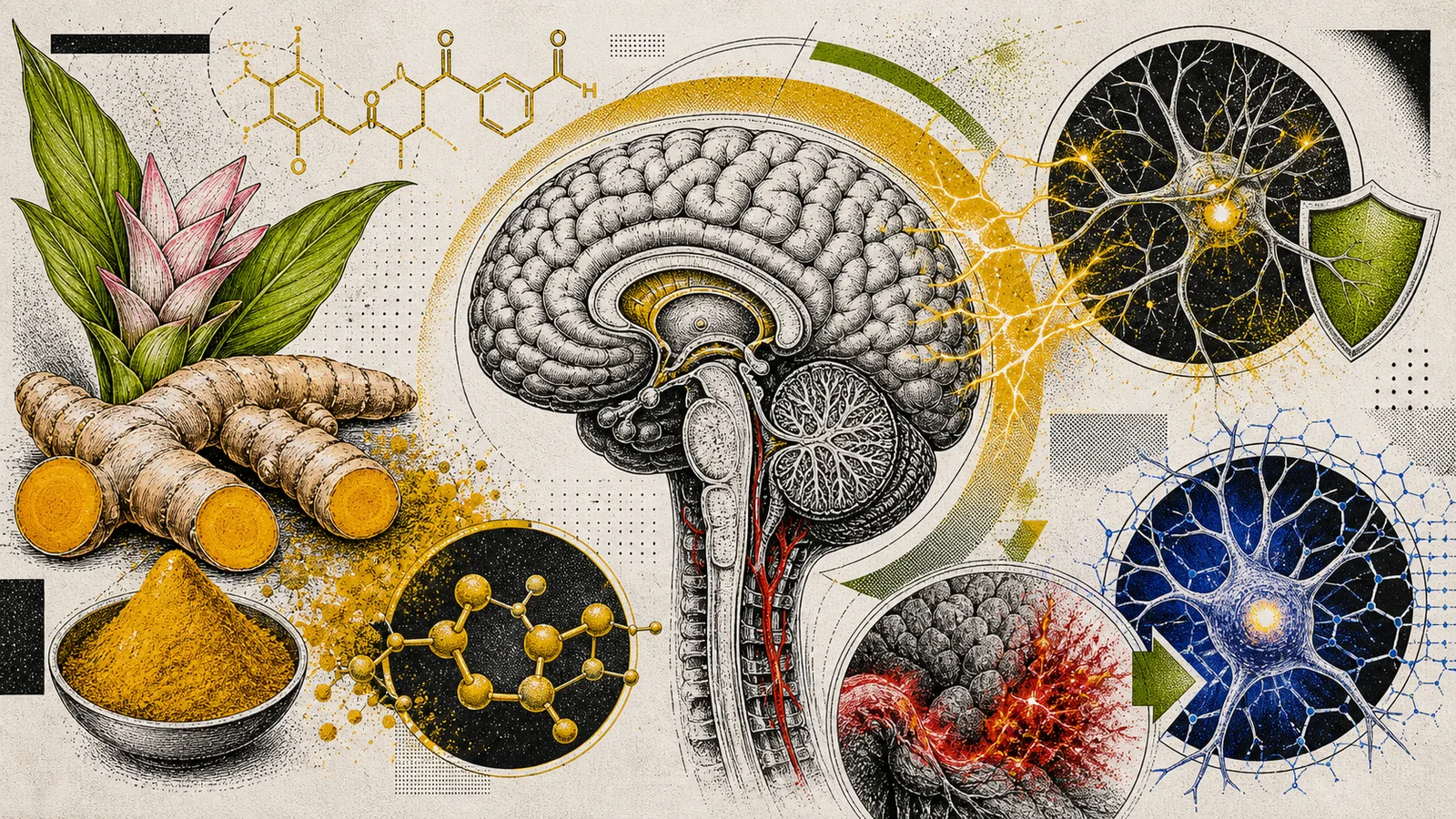
Curcumin (Curcuma longa) is a yellow-orange polyphenol obtained from the root part of the turmeric plant. This compound, chemically known as diferuloylmethane, is the active molecule that gives turmeric its characteristic color and has been used in Indian cuisine and Ayurvedic medicine for thousands of years.
Curcumin has been studied in more than 14,000 scientific publications and is known for its anti-inflammatory and antioxidant properties. Beyond its traditional uses, modern neurobiology research is increasingly examining its direct effects on brain health. For nootropic use, however, bioavailability is a key limitation: very little standard curcumin may enter the body when taken orally.
Mechanism of Effect

The effects of curcumin on the brain are not based on a single mechanism, but on its simultaneous effects on multiple biochemical pathways. This multi-target structure creates both an advantage and a research challenge.
| target | Impact | Conclusion |
|---|---|---|
| NF-kB pathway | inhibition | Reduced systemic neuroinflammation |
| BDNF mRNA | Increased expression | Neuroplasticity, memory enhancement |
| Amyloid-beta plaques | Preventing aggregation | Alzheimer's risk reduction |
| MAO inhibition (mild) | Serotonin/Dopamine protection | Antidepressant effect |
| Nrf2 activation | Increase in antioxidant genes | Oxidative stress reduction |
Among these mechanisms, the strongest clinical support NF-kB inhibition and BDNF increase Available for. Neuroinflammation; It is particularly valuable for curcumin to target this pathway, as it is one of the key contributing factors to depression, Alzheimer's, and general cognitive decline.
Bioavailability Problem
The biggest limitation of curcumin is its bioavailability. When standard curcumin is taken orally, its penetration from the intestinal wall into the blood is extremely low; oral bioavailability less than 1% remains. The main reasons for this are: low water solubility, rapid degradation in the intestinal environment and rapid metabolism in the liver.
To overcome this problem, scientists and supplement manufacturers have developed various formulation solutions:
- Piperine (BioPerine): Black pepper extract. It has been shown to increase the bioavailability of curcumin by approximately 2000%. It is the most common and affordable solution, but it can also affect the metabolism of some drugs.
- Liposomal curcumin: Absorption is increased by taking curcumin into oil-based capsules. Research data shows significantly superior results compared to the standard form.
- Phytosomal forms (Meriva): This form, in which curcumin forms a complex with phosphatidylcholine, has been supported by clinical studies and provides significantly better absorption than the standard form.
- BCM-95 (Bio-Curcumin): Form combined with essential turmeric oils. It has been used in multiple clinical studies.
- Nano formulations: It is in the research phase; It is promising but has not yet become commercially widespread.
| form | Relative Bioavailability | Notes |
|---|---|---|
| Standard Curcumin | Reference (very low) | alone is insufficient |
| + Piperine (BioPerine) | ~20x (≈2000% increase) | The most affordable solution; supported by human data |
| Meriva (Phytosomal) | ~29 times | Confirmed in clinical study |
| Liposomal/nano forms | Significantly higher than standard | Comparative human data is more limited |
Clinical Evidence
Clinical studies on curcumin show promising results, especially in the area of mood and neuroinflammation.
- Sanmukhani et al. (2014): In a 6-week randomized controlled trial, curcumin was evaluated in comparison with fluoxetine (Prozac) in patients with mild to moderate depression. The curcumin group was found to be largely equivalent in effectiveness to the antidepressant drug. This is one of the most important studies that directly proves the antidepressant effect of curcumin on a clinical level.
- Rainey-Smith et al. (2016): This study, conducted in healthy individuals, revealed that curcumin supplementation had positive effects on memory and attention. The results are more evident especially in individuals at risk of age-related cognitive decline.
- Cox et al. (2015): In this study conducted with the solid lipid form of curcumin (Longvida), a significant improvement in mood and fatigue levels was observed in healthy elderly individuals after 4 weeks of use. It is one of the rare studies suggesting that curcumin can have a relatively rapid effect.
- Meta-analyses: Meta-analyses across multiple studies consistently show that curcumin use leads to significant reductions in neuroinflammation biomarkers such as IL-6, TNF-alpha, and CRP.
⚠ Research Limitations
A significant portion of existing studies have small sample sizes and short follow-up periods. Increased bioavailability forms are not comparable to standard curcumin; The use of different forms in different studies makes it difficult to directly compare the results. Research on cognitive effects in healthy young individuals is still limited.
Dosage Protocol
Curcumin dosage varies significantly depending on the form used. Taking standard curcumin in high doses does not increase bioavailability; Choosing the right form is much more decisive than the dose.
| form | Dose | Notes |
|---|---|---|
| + Piperine (BioPerine) | 500–1000 mg/day | Take with food, black pepper |
| Meriva (Phytosomal) | 400–500 mg/day | Research dose; clinically confirmed |
| BCM-95 | 500 mg/day | Form used in clinical studies |
Important note: Curcumin is a fat-soluble compound. Whichever form you use, taking it with a meal containing fat improves absorption. Using turmeric with olive oil or coconut oil in your meals is both delicious and bioavailability supportive.
Safety and Side Effects
Curcumin is one of the rare compounds considered safe within the framework of current research. No serious side effects have been reported even with long-term use of high doses. However, some situations require attention:
- Nausea and diarrhea: Gastrointestinal discomfort may occur at very high doses (over 8 g per day). It is rare at standard doses.
- Interaction with blood thinners: Curcumin has an anticoagulant effect. Those using warfarin or aspirin should be careful.
- May reduce iron absorption: Individuals with iron deficiency anemia should be careful when using high doses of curcumin; It is recommended to take it separately from iron supplements or iron-rich foods.
- Gallbladder problems: Since curcumin may increase bile flow in those with a history of gallstones, a doctor should be consulted before consumption.
Sources
- Sanmukhani J, et al. (2014). Efficacy and safety of curcumin in major depressive disorder: a randomized controlled trial. Phytotherapy Research, 28(4), 579–585. PubMed · PMID 23832433
- Shoba G, et al. (1998). Influence of piperine on the pharmacokinetics of curcumin in animals and human volunteers. Planta Medica, 64(4), 353–356. PubMed · PMID 9619120
- Cox KHM, et al. (2015). Investigation of the effects of solid lipid curcumin on cognition and mood in a healthy older population. Journal of Psychopharmacology, 29(5), 642–651. Search PubMed (match unverified)
- Lopresti AL, et al. (2014). Curcumin for the treatment of major depression: a randomised, double-blind, placebo controlled study. Journal of Affective Disorders, 167, 368–375. PubMed · PMID 25046624
Link verification checks the identity of the publication; it does not constitute independent expert review of clinical claims. Our evidence and source methodology · Source directory
Frequently Asked Questions
Curcumin is the active polyphenol of turmeric and supports brain health through multiple mechanisms. It suppresses neuroinflammation by inhibiting the NF-kB pathway, strengthens neuroplasticity by increasing BDNF (brain-derived neurotrophic factor) expression, and has an antidepressant-like effect through mild MAO inhibition. Positive results on mild to moderate depression, age-related cognitive decline and oxidative stress have been reported in clinical studies.
The dosage varies depending on the form used. 500-1000 mg daily for standard curcumin combined with piperine (BioPerine); 400-500 mg for Meriva, the phytosomal form; For the BCM-95 form, 500 mg is recommended. Taking standard curcumin in high doses does not increase bioavailability; Choosing the right form is much more decisive than the dose. Taking each form with a fatty meal significantly improves absorption.
Curcumin is one of the compounds considered safe according to research. Nausea and diarrhea may occur at very high doses above 8 grams per day; however, this is rare at standard doses. Those who use blood thinners such as warfarin or aspirin should be careful because curcumin has an anticoagulant effect. Those with iron deficiency anemia and a history of gallstones should consult a healthcare professional before use.
The effects of curcumin usually become apparent after 4-8 weeks of regular use. Effects on mood and fatigue have been observed in some studies over a relatively short period of time, as long as 4 weeks. Neuroprotective and cognitive benefits occur with longer-term use. Choosing a form with high bioavailability and taking it with fatty meals may accelerate the onset of effect.
Curcumin is a completely legal dietary supplement in Türkiye; There are no restrictions. It can be easily found in pharmacies, organic food stores and online supplement sellers. Combined products containing piperine and highly bioavailable forms such as Meriva and BCM-95 can also be obtained through domestic vendors. When choosing a product, it is recommended to choose brands that have a third-party testing certificate and whose standardized curcuminoid content is stated.


