Contents 5 dk okuma
Important Note
This page is not medical advice. Although research on shilajit shows promising results, it should not be used to treat any health problems. Remember that raw and unpurified products carry the risk of heavy metals. Consult a healthcare professional.
What is Shilajit?
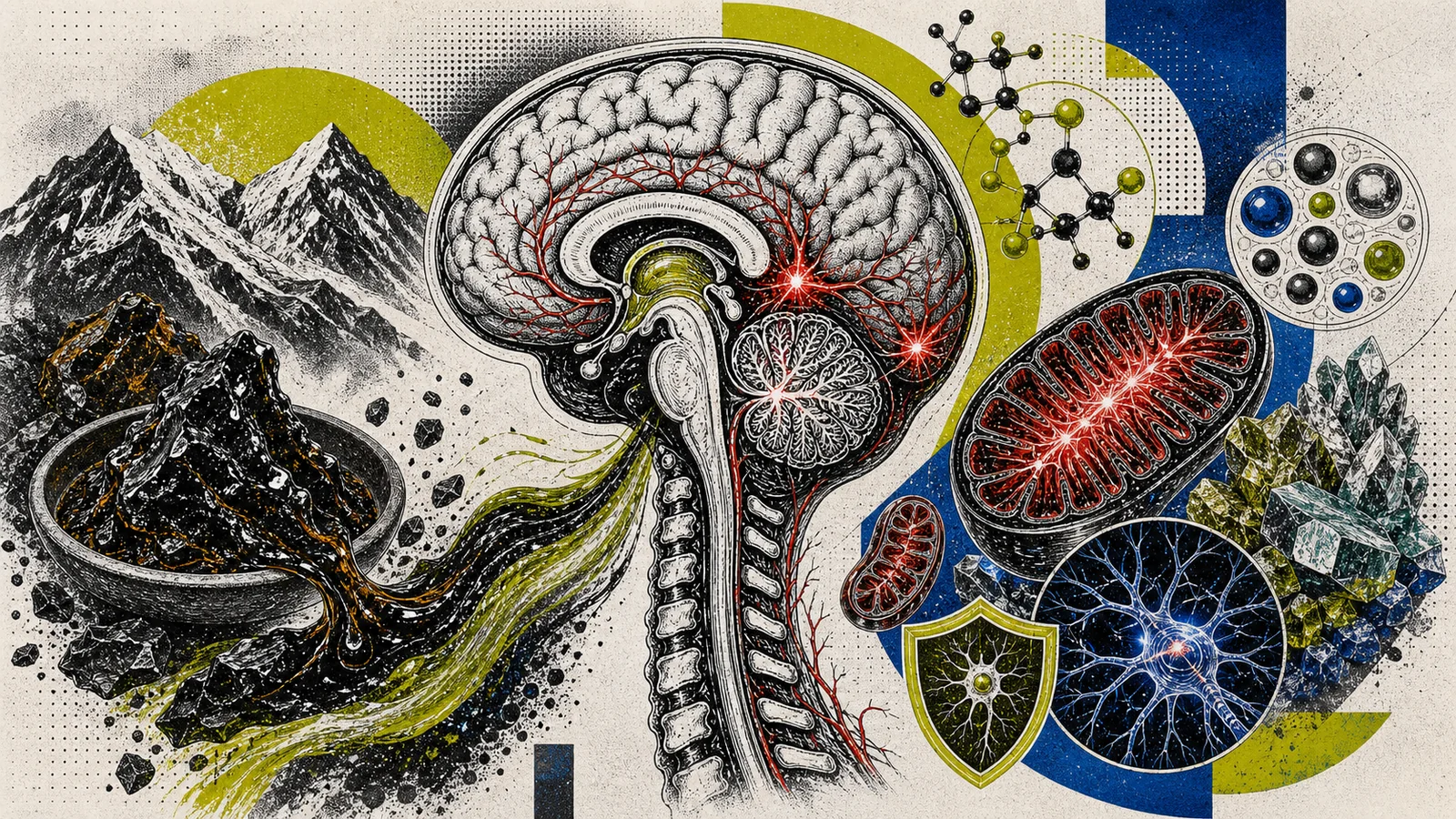
Shilajit is a dark, resinous mineral substance formed by the decomposition of plant matter under geological pressure in the Himalayas, Altai and Caucasus mountains over millions of years. In the Ayurvedic tradition, it is known as "shilajit", which means "mineral tar"; In Russia and Central Asia, it is called "mumijo".
Approximately 15 to 20 percent of the composition of raw shilajit fulvic and humic acids creates; In standardized purified products (e.g., PrimaVie), the fulvic acid content can be increased to approximately 50 percent or more. The remaining part consists of trace minerals, dibenzo-alpha-pyrones and organic compounds. This combination makes shilajit a prominent source of adaptogenic minerals in both Eastern medicine and modern research.
Historically, shilajit has been considered in the "rasayana" (rejuvenating) category in Ayurveda; It has been used for energy, stamina, sexual health and longevity. Modern science has begun to explain some of these traditional uses within the framework of mitochondrial biology and hormonal mechanisms.
Mechanism of Effect

The main active ingredient of shilajit fulvic acidIt is a small molecule organic acid that can pass through cell membranes. It increases ATP production efficiency by facilitating electron transfer within mitochondria. Besides that dibenzo-alpha-pyrones (DBPs) Compounds called activate mitochondrial respiratory chain complexes.
| Compound/Mechanism | Impact | Conclusion |
|---|---|---|
| Fulvic Acid | Facilitating mitochondrial electron transfer | ATP production increases |
| CoQ10 Synergy | Fulvic acid increases CoQ10 bioavailability | Energy chain efficiency increases |
| DBPs (Dibenzo-alpha-pyrones) | Mitochondrial complex activation | Cellular energy production increases |
| Luteinizing Hormone (LH) | Testicular Leydig cell stimulation | Testosterone synthesis increases |
| Mineral Complex | Support for many trace elements | Enzyme cofactors are completed |
Clinical Evidence
Clinical studies on shilajit mainly focus on testosterone and mitochondrial energy parameters. Although the number of available human randomized controlled trials (RCTs) is limited, the results obtained are supportive.
Pandit (2016) In a double-blind, placebo-controlled RCT conducted by et al., healthy men aged 45–55 years were given 250 mg of purified shilajit (PrimaVie, standardized for fulvic acid) twice daily for 90 days. At the end of the study, significant increases of approximately 20 percent (≈20.5%) in total testosterone levels and approximately 19 percent in free testosterone were observed compared to the placebo group. DHEA-S levels are also increased.
Bhatta et al. (2016) In a study conducted on old animals by , it was reported that the combination of shilajit and CoQ10 improved mitochondrial function parameters. The extent to which this result can be transferred to humans has not yet been confirmed.
Biswas et al. (2010) reported that 90-day use of purified shilajit in men with oligospermia improved spermatogenesis parameters such as sperm count and motility. Additionally, some laboratory-level studies have suggested that fulvic acid may protect against tau protein accumulation; however, these neurodegenerative data remain at the cell/animal level and have not been confirmed in humans.
⚠ Research Limitations
The number of human RCTs available is quite limited and sample sizes are small. Effects on testosterone have only been studied in middle-aged men; Data are insufficient for young individuals and women. Cognitive benefits are largely based on animal studies. More comprehensive and long-term clinical studies are needed.
Dosage Protocol
The most commonly researched dosage range for shilajit is 300–500 mg per day. Split doses have been preferred in clinical studies. The table below summarizes recommended protocols for different intended uses:
| Intended Use | Dose | Timing |
|---|---|---|
| General energy / anti-aging | 300–500 mg/day | In the morning, on an empty stomach or with warm water |
| Testosterone support | 250 mg x 2/day | Morning and afternoon |
| Combination with CoQ10 | 200–400 mg sillajit + CoQ10 | Morning together with dinner |
Purification is critical: Raw (unprocessed) shilajit may contain heavy metals such as lead, mercury and arsenic. Be sure to choose products that have been tested for heavy metals and have a standardized fulvic acid percentage. Brands such as PrimaVie and Purblack are referenced in research because they meet these standards. Make sure the product label includes "purified shilajit" and a certified third-party analysis report.
Safety and Side Effects
Purified and standardized forms of shilajit have been found to be well tolerated and safe in existing clinical studies. But product quality is a critical factor:
- Raw/unprocessed forms: May contain heavy metal contamination such as lead, mercury and arsenic; These forms are definitely not recommended.
- Mild GI discomfort: Some users have reported nausea or digestive upset; It can be reduced by taking it with meals.
- Hemochromatosis (iron overload disease): Since shilajit contains trace iron, individuals with this diagnosis should be careful.
- Hormone sensitive conditions: Due to its testosterone-boosting effect, those with a history of hormone-sensitive cancer should consult a doctor before use.
- Pregnancy and breastfeeding: There is not enough data regarding its safety during these periods; It is recommended not to use.
Sources
- Pandit S, et al. (2016). Clinical evaluation of purified Shilajit on testosterone levels in healthy volunteers. Andrologia, 48(5), 570–575. PubMed · PMID 26395129
- Bhatta S, et al. (2016). Shilajit combined with coenzyme Q10 supplementation improves mitochondrial function in aged animals. Journal of Medicinal Food, 19(7), 670–678. Search PubMed (match unverified)
- Biswas TK, et al. (2010). Clinical evaluation of spermatogenic activity of processed Shilajit in oligospermia. Andrologia, 42(1), 48–56. PubMed · PMID 20078516
- Stohs SJ. (2014). Safety and efficacy of shilajit (mumie, moomiyo). Phytotherapy Research, 28(4), 475–479. PubMed · PMID 23733436
Link verification checks the identity of the publication; it does not constitute independent expert review of clinical claims. Our evidence and source methodology · Source directory
Frequently Asked Questions
Shilajit increases mitochondrial ATP production through fulvic acid and dibenzo-alpha-pyrones, supports testosterone synthesis and enhances CoQ10 bioavailability. Thanks to its adaptogenic properties, it reduces fatigue, increases general energy level and compensates for trace mineral deficiencies.
Shilajit is a mineral resin that has a cumulative effect; Instant results should not be expected. Positive changes on energy and fatigue usually begin to be felt after 2–4 weeks of regular use. For hormonal effects such as testosterone support, at least 8–12 weeks of continuous use is recommended.
The dosage range most investigated in clinical studies is 300–500 mg of purified shilajit daily. When used for testosterone support, divided doses of 250 mg in the morning and afternoon are preferred. In combination with CoQ10, 200–400 mg seems sufficient. High doses do not provide extra benefit; On the contrary, it may increase the risk of GI upset.
The most critical point is product quality: raw and unpurified shilajit may contain heavy metal contamination such as lead, mercury and arsenic. Only products with third-party laboratory analysis and a standard fulvic acid percentage should be preferred. People diagnosed with hemochromatosis, those with a history of hormone-sensitive cancer, and pregnant and breastfeeding women should consult a physician before use.
In Türkiye, shilajit is considered a food supplement, not a medicine, and its sale is not subject to any legal restrictions. It is possible to access products of certified brands such as PrimaVie or Purblack in local pharmacies, health stores and licensed online supplement platforms. Raw resin forms obtained from social media or unidentified channels should be avoided due to the risk of heavy metals.


