Contents 3 dk okuma
Information
This content is for educational and informational purposes only; It does not constitute medical advice. If you are experiencing clinical anxiety or stress disorder, consult a specialist physician.
The Two Sides of the Stress Response
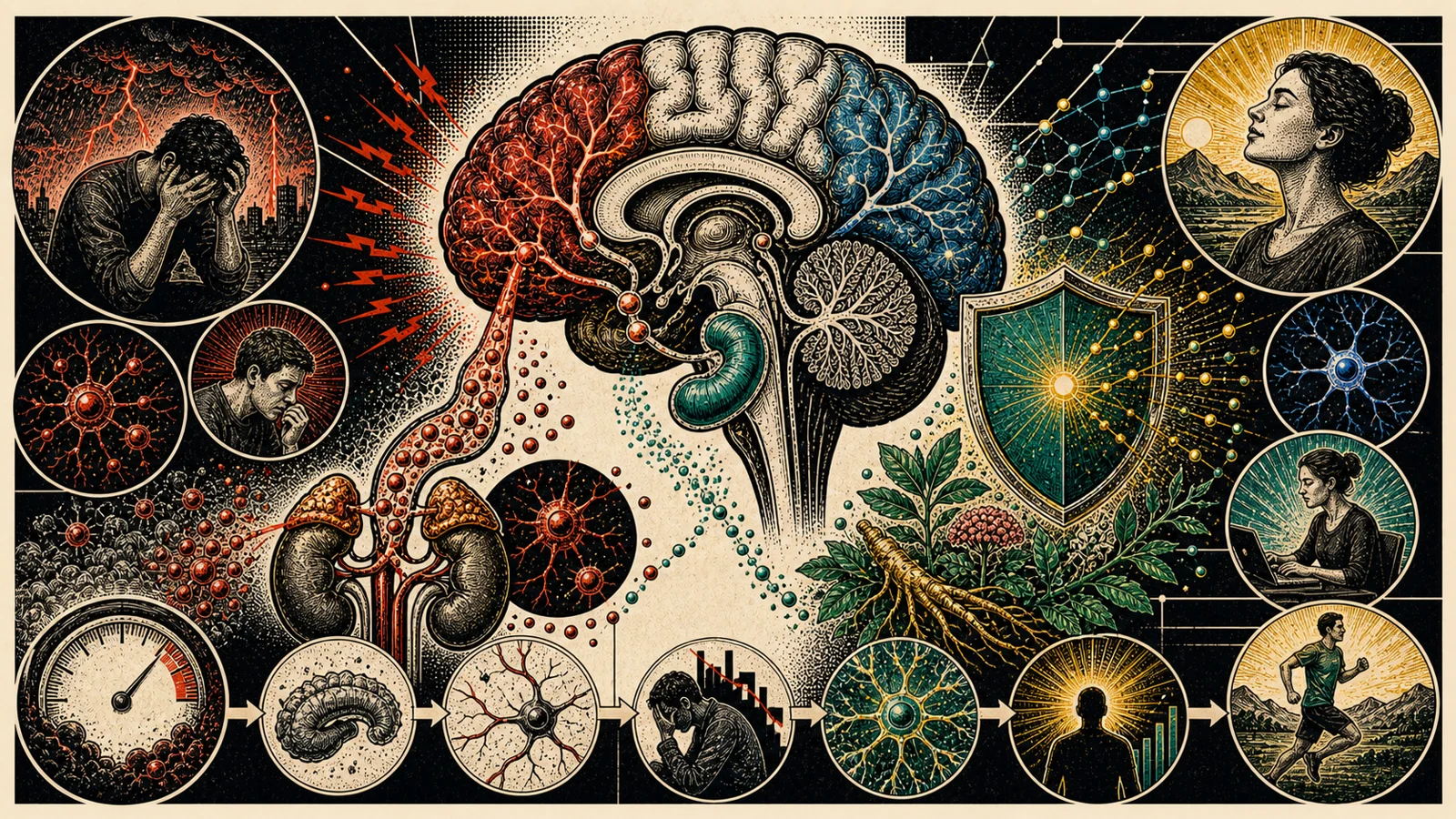
The stress response is an evolutionary gift. Cortisol, secreted through the Hypothalamic-Pituitary-Adrenal (HPA) axis, accelerates the heartbeat, increases blood sugar and stimulates the brain in case of danger. In the short term Increases cognitive speed and attention capacity - so mild tension before the exam can improve performance.
The problem is that this system stays on for a long time. The chronic, low-intensity but persistent stressors of modern life—work pressure, financial anxiety, relationship problems, lack of sleep—permanently activate the HPA axis. And at this point cortisol changes from protective to destructive.
The Damage Cortisol Causes to the Brain

| Brain Region | Effect of Cortisol | Cognitive Outcome |
|---|---|---|
| hippocampus | Dendrite atrophy, neurogenesis suppression, volume loss | Creating new memories becomes difficult, forgetfulness increases |
| Prefrontal Cortex | Dopaminergic circuit weakening, synaptic loss | Attention is distracted, decision making is impaired, impulse control decreases |
| Amygdala | Overactivation and hypertrophy | Anxiety, tendency to panic, increased emotional reactivity |
| Neurogenesis (DG) | BDNF suppression | New neuron production stops, learning capacity decreases |
Research shows that the hippocampus of individuals under chronic stress is measurably smaller than that of controls. Good news: This process is partially reversible. When cortisol is reduced, neurogenesis restarts and brain volume can recover.
Adaptogenic Nootropics: Balancing the HPA Axis
Adaptogens are herbal compounds that target excessive activation of the HPA axis and promote stress adaptation. Their mechanism is very different from sympathomimetic stimulants: instead of blunting the stress response, they arrange - They normalize both underreaction and overreaction.
Ashwagandha (Withania somnifera)
ashwagandha's withanolide compounds strengthen the cortisol feedback loop by binding to glucocorticoid receptors. 60 days of KSM-66 extract use has been shown to reduce cortisol by 27.9% (Chandrasekhar et al., 2012). Additionally, it also shows an anxiolytic effect through GABA-A modulation.
rhodiola rosea
RhodiolaIt reduces mental fatigue and alleviates stress-induced cognitive impairment through salidroside and rozavin compounds. It works by increasing stress tolerance rather than directly suppressing cortisol; During periods of acute fatigue and intense work, the effect appears early - sometimes in the first week.
Tongkat Ali (Eurycoma longifolia)
Tongkat Alihas been tested in double-blind studies to reduce cortisol and improve the testosterone/cortisol ratio, especially in stressed individuals. Talbott et al. (2013) found that cortisol decreased by 16% in 4 weeks of use.
Beyond Cortisol Reduction: Direct Neuroprotection
Some nootropics work not through cortisol, but by directly repairing the damage caused by cortisol:
- Lion's Mane: Supports dendrite repair by increasing NGF – critical in reversing stress damage
- Bacopa Monnieri: Reduces oxidative stress-induced neuronal damage and supports BDNF
- NAC: Provides protection against cortisol-induced oxidative damage through glutathione
- Omega-3 (DHA): Supports hippocampal neurogenesis and BDNF synthesis
Practical Protocol
| target | Priority Response | Nootropic Support |
|---|---|---|
| acute work stress | Exercise, breathing techniques | Rhodiola (morning), L-Theanine (daytime) |
| chronically high cortisol | Sleep patterns, social support | Ashwagandha (2×/day, with food) |
| Stress-induced brain fog | Meditation, digital detox | Lion's Mane + Omega-3 (long term) |
| Hormone imbalance disorder | Physician evaluation | Tongkat Ali (cyclical) |
⚠ Supplementation Alone Is Not Enough
Adaptogenic nootropics supplement, not replace, lifestyle changes. Without adequate sleep, regular exercise and management of stressors, no supplement can provide lasting effects.
Sources
- Chandrasekhar K, et al. (2012). A prospective, randomized double-blind, placebo-controlled study of safety and efficacy of KSM-66 ashwagandha. Indian Journal of Psychological Medicine, 34(3), 255–262. Search PubMed (match unverified)
- Talbott SM, et al. (2013). Effect of Tongkat Ali on stress hormones and psychological mood state. Journal of the International Society of Sports Nutrition, 10, 28. Search PubMed (match unverified)
- McEwen BS. (2007). Physiology and neurobiology of stress and adaptation: central role of the brain. Physiological Reviews, 87(3), 873–904. PubMed · PMID 17615391
- Sapolsky RM. (1996). Why stress is bad for your brain. Science, 273(5276), 749–750. PubMed · PMID 8701325
Link verification checks the identity of the publication; it does not constitute independent expert review of clinical claims. Our evidence and source methodology · Source directory
Frequently Asked Questions
Yes. Chronically high cortisol negatively affects the hippocampus – the center of creating new memories; It causes dendrite atrophy and BDNF suppression, making learning and memory consolidation difficult.
Ashwagandha (KSM-66) and Tongkat Ali are among the adaptogens that have been shown in clinical studies to significantly reduce cortisol. Rhodiola, on the other hand, works by increasing stress tolerance rather than directly reducing cortisol.
Long-term chronic stress can lead to measurable hippocampal volume loss; however, this process is largely reversible. When stress is reduced and exercise and sleep are supported, neurogenesis is reactivated and the brain structure can recover.
Ashwagandha is the strongest initial candidate in terms of safety profile and clinical evidence. If acute fatigue predominates, Rhodiola can be added. The two can be used together; The combination of Rhodiola in the morning and Ashwagandha in the evening is a common protocol.


